mobile Ansicht, to the English Version tap the flag

- Kap-Kolonie
- auch: Kapland
- seit 1814 Britische Kolonie
- ab 1910 Provinz Südafrikas (Kapprovinz, Kaapprovinsie)
- 1994 aufgeteilt
• Flaggen
• Bedeutung/Ursprung der Flagge
• Wappen
• Bedeutung/Ursprung des Wappens
• Landkarte
• Zahlen und Fakten
• Geschichte
• Ursprung des Landesnamens
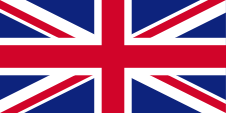
1814–1875,
Flagge Großbritanniens,
Seitenverhältnis = 1:2,
Quelle:
Flags of the World


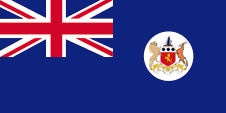
1875–1910,
Flagge der Regierung (Staatsflagge),
Seitenverhältnis = 1:2,
Quelle:
Wikipedia (D), Flags of the World


Die Flagge der Kapkolonie war ein sogenannter "Blue Ensign", ein dunkelblaues Flaggentuch mit einer Flaggendarstellung – dem britischen Union Jack – in der Oberecke. Der Union Jack weist auf die Verbindungen zu Großbritannien hin. Die Flagge war zur Verwendung von Ämtern und Dienstellen gedacht und eigentlich auch nur zur See. Die Einwohner hatten weiterhin den britischen Union Jack zu verwenden. Großbritannien hatte in Jahr 1864 ein Flaggensystem eingeführt, in dem:
• Kriegsschiffe einen sogenannten "White Ensign" (Marineflagge), eine weiße Flagge oft mit durchgehendem roten Georgskreuz und mit dem Union Jack in der Oberecke,
• Handelsschiffe einen "Red Ensign" (auch "Civil Ensign" → Bürgerflagge genannt, die eigentl. Handelsflagge), eine rote Flagge mit dem Union Jack in der Oberecke, und
• Dienstschiffe einen "Blue Ensign" (Regierungsflagge → die eigentl. Staatsflagge), eine blaue Flagge mit dem Union Jack in der Oberecke führten.
Seit 1865 durften Schiffe von Kolonialregierungen einen Blue Ensign mit einem Badge (Abzeichen) im fliegenden Ende führen. Die jeweiligen Regierungen sollten entsprechene Bagdes zur Verfügung stellen. Handelsschiffe und seefahrende Privatpersonen aus Kolonien dürfen nur dann einen Red Ensign mit Badge führen, wenn von der britischen Admiralität eine entsprechende Erlaubnis für die Kolonie erteilt wurde. Ein solches Badge war oft eine auf einer Scheibe platzierte regionale landschaftliche Darstellung, zeigte oft Schiffe, historische Begebenheiten oder konnte auch nur eine Art Logo sein. Sehr oft zeigte ein Badge zusätzlich den Namen des Landes oder auch einen Wahlspruch. Einige Besitzungen hatten aber auch schon von Anfang an ein Wappen, bzw. erhielten über die Jahre eine eigenes Wappen und das Badge wurde abgeschafft. Um ein weitgehend einheitliches Erscheinungsbild im fliegenden Ende der Flaggen zu gewährleisten, wurden Wappen und auch andere Symbole auf einer weißen Scheibe in der Größe der früheren Badges dargestellt. Es gab hier aber auch Ausnahmen, denn einige Kolonien verwendeten diese weiße Scheibe nicht, und platzierten ihr Wappen oder auch nur das Wappenschild - manchmal auch vergrößert - direkt auf das Flaggentuch. Schon in den 40-er Jahre wurde dazu übergegangen die weiße Scheibe zu entfernen und das Wappen direkt zu platzieren oder vergrößert dazustellen. Dieser Umstellungsprozess erfolgte allmählich, nirgendwo gleichzeitig und vollständig. In einigen britischen Besitzungen sind bis heute Flaggen mit der weißen Scheibe in Gebrauch, in anderen nicht mehr und in einigen Gebieten gibt es beide Varianten nebeneinander. Die Kapkolonie erhielt im Jahre 1875 ein eigenes Wappen, das auf einer weißen Scheibe im fliegenden Ende des "Blue Ensign" gezeigt wurde. Als Provinz Südafrikas hatte das Land bis 1994 keine eigene Flagge mehr.
Quelle:
Die Welt der Flaggen, Flags of the World
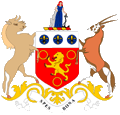
Wappen der Kapkolonie,
Quelle, nach:
Flags of the World
Das Wappen der Kapkolonie zeigte ein rotes Schild mit einem goldenen Löwen, der von drei goldenen Ringen umgeben ist. Im Schildhaupt ein silbernes Feld mit drei blauen Scheiben die jeweils eine goldenen Lilie in sich tragen. Schildhalter waren ein Gnu und eine Antilope. Oberhalb des Schildes ein golden-roter Wulst und darauf eine Frauengestalt mit einem Anker, die an einem Felsen lehnt. Sie symbolisiert die Hoffnung. Unterhalb des Schildes ein silbernes Spruchband mit dem Motto der Kolonie: "Spes Bona" → "Gute Hoffnung". Das Motto und auch die Frauengestalt sind Anspielungen auf das Kap der Guten Hoffnung.
Quelle:
Flags of the World
Landkarte des Landes:
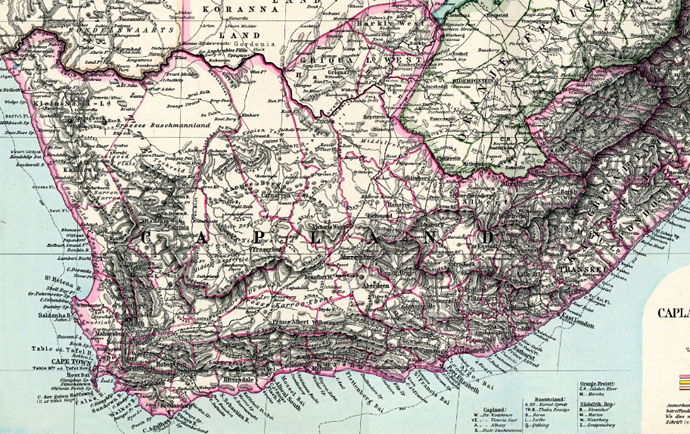
Quelle/Source:
www.maproom.org
Burenrepubliken und Britische Kapkolonie, heutige Grenzen in Rot:
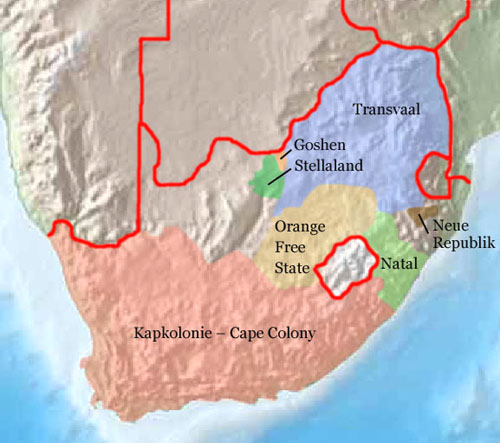
Quelle/Source:
Freeware, University of Texas Libraries,
modyfied by: Volker Preuß
Fläche: 721.001 km² (1982), 571.690 km² (1891)
Einwohner: 6.722.000 (1982), 1.526.500 (1891)
Hauptstadt: Kapstadt (Cape Town, Kaapstad), 691.000 Ew. (1970)
Sprachen: Afrikaans, Englisch, Bantusprachen
Zeitzone: MEZ + 1 h
Quelle, nach:
Politische Gliederung der Erde, Brockhaus Konversationslexikon
Antike/Mittelalter · im heutigen Südafrika leben Khoisanide Völker (so genannte Hottentotten oder Buschmänner)
1488 · der portugiesische Seefahrer Bartolomëu Diaz erreicht das Kap der Guten Hoffnung
1497 · der portugiesische Seefahrer Vasco da Gama umsegelt das Kap der Guten Hoffnung auf dem Weg nach Indien
15./16. Jahrhundert · Einwanderung schwarzer Bantu-Völker (Ndebele, Xhosa, Zulu, Sotho, Tswana, Swati, Venda, Tsonga ...)
1602 · die Niederländer nehmen das Land um das Kap der Guten Hoffnung in Besitz (Kapland), Besiedlung durch Buren (Bauern niederländischer und deutscher Abstammung, Eigenbezeichnung: Afrikaander)
1652 · Jan van Riebeeck gründet die Siedlung Kapstadt im Auftrag der Niederländisch-Ostindischen Kompanie
1806 · Großbritannien besetzt das Kapland
1814 · Großbritannien nimmt Kapland offiziell in Besitz, Gründung der Britischen Kapkolonie
1833 · Aufhebung der Sklaverei
1836–1885 · die Buren verlassen in langen Treks das Kapland in Richtung Osten und Nordosten und gründen mehrere Burenrepubliken (1838 Natal, 1854 Oranje-Freistaat, 1853 Transvaal, 1883 Stellaland, 1883 Goshen, 1884 Neue Republik ...), die britische Kolonialmacht verfolgt die Buren
1866 · Anschluss der Kolonie Kaffaria (im Süden des heutigen Südafrikas) an die Kapkolonie
1885 · Anschluss von Goshen und Stellaland (im Norden des heutigen Südafrikas) an die Kapkolonie
1887 · Anschluss von Zululand (im Osten des heutigen Südafrikas) an die Kapkolonie
1894 · Anschluss von Pondoland (im Süden des heutigen Südafrikas) an die Kapkolonie
1895 · Anschluss von Süd-Betschuanaland (im Norden des heutigen Südafrikas) an die Kapkolonie
1910 · Großbritannien schließt die Kolonien Oranje-Freistaat, Transvaal, Natal und Kapprovinz zur Südafrikanischen Union zusammen, Status eines britischen Dominions für Südafrika
27.04.1994 · neue Verfassung für Südafrika, Aufteilung der Kapprovinz
Quelle:
Atlas zur Geschichte,
Wikipedia (D),
Discovery '97,
Weltgeschichte
Der Name "Kapkolonie" bezieht sich auf die Lage des Landes am Kap der Guten Hoffnung. Die Niederländer nannten es "Kapland" und als Provinz Südafrikas wurde das Land "Kapprovinz" genannt.
Quelle:
Volker Preuß