mobile Ansicht, to the English Version tap the flag


- Fürstentum Walachei
- ehemaliger Staat und heute historische Region in Rumänien
- Eigenbezeichnung: Principatul Tării Românesti
- andere Bezeichnungen: Vlachia, Muntenia
• Flaggen
• Bedeutung/Ursprung der Flagge
• Wappen
• Bedeutung/Ursprung des Wappens
• Landkarte
• Zahlen und Fakten
• Geschichte
• Ursprung des Landesnamens

14.–15. Jhd.,
Flagge des Fürstentums Walachei,
Quelle, nach:
Flags of the World


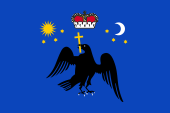
18./19. Jhd.,
Flagge des Fürstentums Walachei,
Quelle, nach:
Flags of the World

19. Jhd.,
Landesfarben des Fürstentums Walachei,
auch farblich umgekehrt,
Quelle, nach:
Flaggen und Wappen der Welt,
Die Welt der Flaggen

ca. 1843–1861,
Landesfarben des Fürstentums Walachei,
Quelle, nach:
Flags of the World
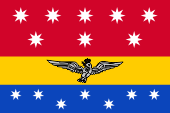
ca. 1843–1861,
Marineflagge,
Quelle, nach:
Flags of the World

ca. 1843–1861,
Kriegsflagge,
Quelle, nach:
Flags of the World
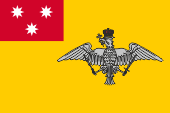
ca. 1843–1861,
Nationalflagge,
Variante,
Quelle, nach:
Flags of the World
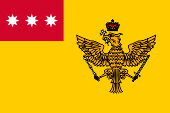
ca. 1843–1861,
Nationalflagge,
Variante,
Quelle, nach:
Flags of the World

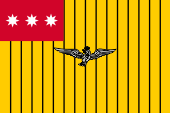
ca. 1843–1861,
angebliche Handelsflagge,
Quelle, nach:
Flaggen aller Seefahrenden Nationen,
Flags of the World

19. Jhd.,
Landesfarben des Fürstentums Walachei (?),
Quelle, nach:
Flaggen Enzyklopädie

Das Wappen des Landes zeigt einen schwarzen Raben auf Blau. Normalerweise hätten die Flaggen des Landes zunächst dieses Bild zeigen sollen. Quellen aus dem 14. und 15. Jahrhundert berichten jedoch, dass es zunächst weiße Flaggen mit dem schwarzen Raben gegeben habe. Was das für Gründe hatte, ist unbekannt. In späteren Quellen des 18. und vom Anfang des 19. Jahrhunderts werden blaue Flaggen mit dem schwarzen Raben beschrieben, der sich allmählich zu einem Adler umwandelte oder gar als Mischwesen auftauchte. In der ersten Hälfte des 19. Jahrhunderts verlieh Sultan Mahmud II. den Walachischen Truppen gelb-blaue Wimpel, so dass diese Farben als Landesfarben angenommen werden können. Ab etwa 1843 scheint die Farbe Rot in den Kreis der Landesfarben aufgenommen worden zu sein (aus welchem Anlass ist unbekannt), denn diese drei Farben finden sich auf Truppenfahnen, der Marineflagge und auch der Kriegsflagge. Die Nationalflagge ist rätselhaft, denn es scheinen verschiedene Versionen überliefert. Übereinstimmend wird die gelbe Flagge mit der roten Oberecke und den drei Sternen genannt, ähnlich dem Modell des Fürstentums Moldau, jedoch ist die Abbildung des Adlers sehr verschieden. Schriftlich überliefert ist der Adler in hellblau (das würde einigermaßen zu den Landesfarben passen), scheint aber als silbern wahrgenommen worden zu sein und in der Praxis sogar golden oder naturfarben im Einsatz gewesen zu sein, obwohl die Heraldik Silber und Gold verbieten würde und erst recht Gold auf Gold. Auch eine angebliche Handelsflagge wird gemeldet, mit 15 senkrechten Streifen über die Grundfläche der gelben Flagge, was in der Praxis, auf Grund der Schwierigkeiten in der Herstellung einer solchen Flagge, gar nicht vorstellbar ist. Immerhin zeigen alle diese Varianten lediglich Rot und Gelb, so dass einige Quellen auch Rot und Gelb als die Landesfarben der Walachei angeben, eine grobe Abweichung von den Farben des Wappens und sehr zweifelhaft. Das ist immer dann von Bedeutung, wenn es um den Ursprung der Farben der rumänischen Flagge geht. Die rumänischen Farben Blau, Gelb und Rot entstanden während der Revolution der Jahre 1848/1849 durch die Kombination der Farben des Fürstentums Walachei und des Fürstentums Moldau, nämlich Gelb/Blau und Rot/Blau. Es hat aber eher den Anschein, das Blau, Gelb und Rot schon vorher in der Walachei verwendet wurden, und auch der offizielle Name des Fürstentums Walachei "Principatul Tării Românesti" zeigte schon die Verwendung des Therms "Rumänisch". Wie auch immer, im Jahre 1861 entstand der Staat Rumänien durch die Vereinigung dieser beiden Fürstentümer.
Quelle:
Flags of the World,
Flaggen und Wappen der Welt,
Die Welt der Flaggen,
Wikipedia (EN),
Volker Preuß
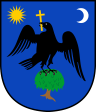
Wappen der Walachei,
Quelle:
Flags of the World
Das Wappen des Landes zeigte einen schwarzen, auffliegenden Raben auf Blau, auf einem Wacholderbusch, der ein goldenes Kreuz im Schnabel hält. Links und rechts des Kopfes erscheinen die Sonne und der Mond. Der schwarze Rabe wandelte sich allmählich, über die Jahrhunderte zu einem Adler, oder wurde gar als Mischwesen dargestellt. Der spätere Adler der Walachei dominiert bis heute die Heraldik ganz Rumäniens.
Quelle:
Flags of the World,
Volker Preuß
Die historischen Regionen in Rumänien:
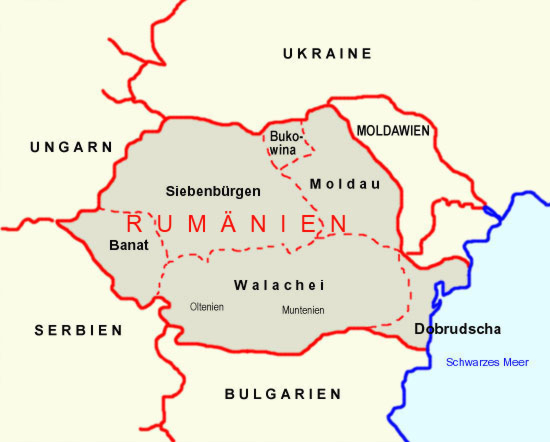
Landkarte:
Volker Preuß
Fläche: ca. 74.500 km² (ca. 1860)
Einwohner: 3.000.000 (ca. 1860)
Hauptstadt: Bukarest (rum.: Bucuresti), 107.000 Ew. (ca. 1860)
Sprachen: Walachisches Rumänisch
Währungen: Piaster, Lei, seit ca. 1860 rumänische Währung
Zeitzone: MEZ + 1 h
Quelle:
Pierer's Universal-Lexikon, 4. Auflage, 1857–1865
ca. 2000 v.Chr. · Herausbildung des Volkes der Thraker in Dakien (heutiges Siebenbürgen)
7. Jahrhundert v.Chr. · Gründung griechischer Kolonien an der Küste des Schwarzen Meeres
70–44 v.Chr. · legendäre Herrschaft des thrakischen Königs Burebista
106 · der Römische Kaiser und Heerführer Trajan erobert Dakien, Eingliederung als Provinz Dacia
4. bis 6. Jahrhundert · Völkerwanderung, durch die Ausbreitung der Hunnen in Mittelasien werden ganze Völkerschaften nach Westen gedrängt, die Hunnen schieben die Slawen vor sich her, und diese die Germanen, die Germanen weichen auf das Gebiet des Römischen Reichs aus
270 · die römischen Truppen ziehen sich aus Dakien zurück
271/272 · der Römische Kaiser Aurelian überlässt Dakien offiziell den Westgoten
441 · die Hunnen durchziehen Dakien und unterwerfen es
453 · Tod des Hunnenkönigs Attila
454 · Abzug der Hunnen
6. Jahrhundert · Einwanderung von Slawen
7. Jahrhundert · aus den verbliebenen Dako-Römern entsteht das Volk der Dako-Romanen
800 · Vernichtung des Awarenreichs durch Karl den Großen, Dakien wird zeitweilig von Bulgaren beherrscht
9. bis 13. Jahrhundert · Invasionen der Petschenegen, Kumanen und Tataren
13. Jahrhundert · ein Volk der Rumänen wird erstmals urkundlich erwähnt
1300–1330 · Vereinigung kleinerer rumänischer Fürstentümer (Oltenien, Muntenien ...) zum Fürstentum Walachei
1387 · Abhängigkeit von Polen-Litauen
1400 · erste türkische Angriffe die Walachei
1415 · das Fürstentum Walachei wird dem Osmanischen Reich (Türkei) tributpflichtig
1461 · Fürst Stephan der III. von Moldau (der Große, ca. 1435–1504) erwibt die Walachei
1475 · Aufstand des Fürstentums Moldau unter Fürst Stephan dem Großen, Sieg über die Türken, Wiederherstellung der Unabhängigkeit von Moldau und Walachei
1511 · die Walachei wird vom Osmanischen Reich unter beschränkter innerer Autonomie annektiert
1593 · Michael der Tapfere (Mihai Viteazul) wird Fürst der Walachei
1595 · Michael der Tapfere besiegt die Türken
1599 · Michael der Tapfere wird kurzzeitig Fürst von Siebenbürgen
1600 · Michael der Tapfere wird Fürst von Moldau
19.08.1601 · Michael der Tapfere wird ermordet, Walachei und Moldau müssen die türkische Oberhoheit endgültig anerkennen
1711 · die Türken besiegen die moldauisch-russischen Befreiungsarmeen, die Fürsten der Moldau und der Walachei werden abgesetzt und durch griechische Statthalter (Phanarioten) ersetzt
1716–1718 · Türkenkrieg
21.07.1718 · Friede von Passarowitz (Pozarevac), das Osmanische Reich tritt das Banat, die Kleine Walachei und Nordserbien an das Haus Habsburg ab
1739 · die Kleine Walachei und Nordserbien werden wieder an das Osmanische Reich übergeben
ab 1774 · wieder Zunahme des russischen Einflusses
1821 · großer Anti-Türkischer Aufstand in der Walachei unter Tudor Vladimirescu, griechischer Nationalaufstand in Griechenland, die Phanariotenherrschaft wird durch das Osmanische Reich beendet
1828–1829 · Russisch-Türkischer Krieg, Niederlage der Türkei, Russland errichtet eine Art Protektorat über Moldau und Walachei, die türkische Oberhoheit bleibt jedoch bestehen
1848–1849 · bürgerlich-demokratische Revolution in der Walachei, der Fürst der Walachei tritt vorübergehend zurück, die Revolution wird durch türkische und russische Truppen niedergeschlagen
1856/58 · Krimkrieg, Pariser Verträge, das russische Protektorat wird zugunsten eines Protektorats von sieben Europäischen Staaten ersetzt
1859 · Oberst Alexandru Ioan Cuza wird zum Fürsten von Walachei und Moldau gewählt
1861 · Fürst Ioan Cuza proklamiert das Fürstentum Rumänien durch Vereinigung von Walachei und Moldau
Quelle:
Atlas zur Geschichte,
Wikipedia (EN),
World Statesmen,
Pierer's Universal-Lexikon, 4. Auflage, 1857–1865
Die Griechen nannten das Land "Vlachia", woher sich der Name des Landes ableitet. Die Bewohner nannten sich dagegen selbst "Român", also "Römer", ein Hinweis auf ihre Herkunft. Im benachbarten deutschen Sprachraum wurden die Bewohner des Landes zu "Walachen", was prägend für den Landesnamen im Ausland wurde. Die Walachen selbst nannten ihr Land "Muntenia", bei den Türken hieß es "Ak-Iflak". Die Walachei besteht aus der Kleinen Walachei (Oltenien) westlich des Flusses Alt (Olt) und der Großen Walachei (Muntenien), östlich des Flusses Alt (Olt).
Quelle:
Wikipedia (DE),
Volker Preuß