mobile Ansicht, to the English Version tap the flag


- Basilicata (Basilikata)
- Region Italiens
- früherer Name: Lukanien
• Flagge
• Bedeutung/Ursprung der Flagge
• Landkarte der Regionen Italiens
• Zahlen und Fakten
• Geschichte
• Ursprung des Landesnamens

Flagge der Basilicata,
Seitenverhältnis = 2:3,
Quelle, nach: Wikipedia (D)


Die Flagge der Basilicata ist einfarbig blau, und zeigt in ihrer Mitte das Wappen der Region. Dieses ist ein golden umrandeter silberner Schild, mit vier horizontalen blauen Wellenlinien in der Mitte. Diese repräsentieren die vier wichtigen Flüsse der Region: Basenot, Agri, Bradano und Sinni.
Quelle: Wikipedia (D)
alle Bezeichnungen in Italienisch
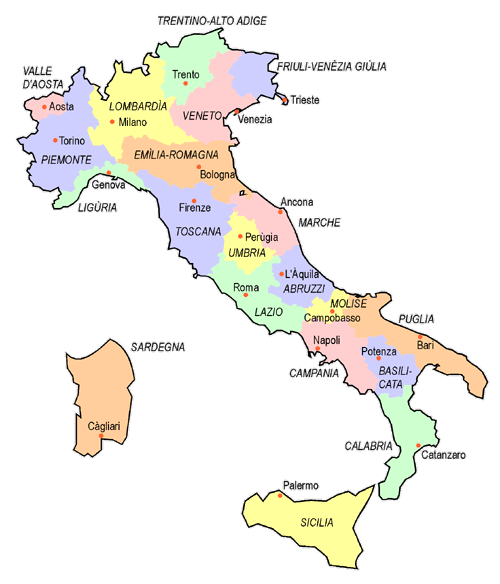
Quelle: Volker Preuß
Fläche: 9.994 km²
Einwohner: 557.000 (2019)
Bevölkerungsdichte: 56 Ew./km²
Hauptstadt: Potenza, 66.500 Ew. (2019)
Amtssprache: Italienisch
Zeitzone: MEZ
Quelle: Wikipedia (D)
4.–5. Jhd. v.Chr. · die Lukanier siedeln in der Gegend der heutigen Basilicata (Lukanien), ständige Kämpfe gegen griechische Kolonisten
ca. 270 v.Chr. · die Lukanier werden Bundesgenossen Roms
410 n.Chr. · Einfall der Westgoten
476 · Absetzung des letzten römischen Kaisers Romulus Augustulus, Ende des (West)Römischen Reiches, Lukanien gehört bis 493 zum Reich des Odoaker
544 · Eroberung durch Byzanz (Ostrom)
568/569 · Langobarden erobern einen großen Teil Süditaliens, so auch Lukanien, und gründen das Herzogtum Benevent
774 · Eroberung Norditaliens durch die Franken, das Herzogtum Benevent kommt unter fränkische Oberhoheit
888 · Nach dem Aussterben der Karolinger erobern die Byzantiner Lukanien zurück
1061–1091 · Eroberung Siziliens durch die Normannen, Bildung des Königreiches Sizilien
1130 · Unteritalien mit den langobardischen Fürstentümern, der Stadt Neapel, und den von den Byzantinern verlassenen normannischen Gebieten werden mit dem normannischen Königreich Sizilien vereinigt, Lukanien ist ein Bestandteil davon und bleibt mit dem Königreich Sizilien (bzw. zwischen 1282 und 1815 mit dem Königreich Neapel) bis 1861 verbunden
1194 · das Königreich Sizilien kommt an das Haus Hohenstaufen
1266 · das Königreich Sizilien kommt an das Haus Anjou, Neapel wird ständige Hauptstadt des Reiches
1282 · "Sizilianische Vesper" – durch einen Volksaufstand kommt die Insel Sizilien als Königreich an das Haus Aragón, Unteritalien verbleibt als Königreich Sizilien (inoffiziell auch Königreich Neapel) bis 1442 bei Anjou
1495 · das Königreich Neapel wird französischer Besitz
1529 · das Königreich Neapel wird Besitz des Hauses Habsburg
1556 · das Königreich Neapel kommt an die spanische Linie des Hauses Habsburg
1701–1714 · Spanischer Erbfolgekrieg
1714 · Friedensvertrag von Utrecht, das Königreich Neapel und das Königreich Sardinien kommen an die österreichischen Habsburger, das Königreich Sizilien kommt an Savoyen-Piemont
1720 · Savoyen-Piemont tauscht mit Österreich Sizilien gegen Sardinien, das Königreich Sizilien kommt somit an das Haus Habsburg (Königreich Neapel-Sizilien)
1734 · das Haus Habsburg überlässt das Königreich Neapel-Sizilien dem Haus der Spanischen Bourbonen
Januar 1799 · Einmmarsch französischer Revolutionstruppen, im Königreich Neapel wird die Bourbonen-Herrschaft beendet, Proklamation der Parthenopäischen Republik, der König flieht nach Palermo, Abzug der französischen Truppen, die Insel Sizilien bleibt beim Haus Bourbon
Juni 1799 · anti-französischer Aufstand, Sturz der Republik, der König kehrt zurück
1806 · Einmarsch französischer Truppen unter Napoléon I., Napoleón inthronisiert seinen Bruder Joseph Bonaparte als König von Neapel
1808 · Joseph Bonaparte wird König von Spanien, Napoleón inthronisiert seinen Schwager Joachim Murat als König von Neapel
1815 · Wiener Kongress, Neuordnung Europas nach der Ära Napoléon, das Königreich Sizilien und das Königreich Neapel kommen an die Spanischen Bourbonen
08.12.1816 · Gründung des Königreichs beider Sizilien unter den spanischen Bourbonen
1860 · Garibaldis Feldzug gegen das Königreich beider Sizilien, der König geht ins Exil, Garibaldi regiert als Diktator
1861 · das Königreich beider Sizilien muss sich dem Königreich Italien anschließen
1947 · Gründung der Region Basilicata als Verwaltungseinheit
Quelle:
Meyers Konversationslexikon,
Atlas zur Geschichte,
Wikipedia (D)
"Bei den Römern hieß die Region Lucania. Im Mittelalter wurde sie von Byzanz erobert, die als Spitze der Verwaltung einen so genannten Basilikós einsetzten. Der traditionelle Name Lucania wurde 1932 von Mussolini wieder aufgenommen, seit 1945 heißt die Region offiziell Basilikata. Die Begriffe Lukanien / lukanisch werden aber noch heute für das Gebirge benutzt, das die Region durchzieht."
Quelle: Zitat/quote: www.reise-nach-italien.de

Mit freundlicher Untersützung von: