mobile Ansicht, to the English Version tap the flag

- Westfalen
- ehemalige preußische Provinz
- 1946 aufgelöst
• Flaggen
• Bedeutung/Ursprung der Flagge
• Wappen
• Bedeutung/Ursprung des Wappens
• Landkarte
• Zahlen und Fakten
• Geschichte
• Ursprung des Landesnamens
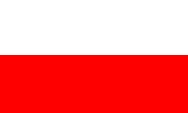
Landesfarben,
Seitenverhältnis = 3:5


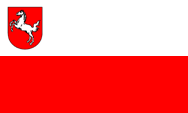
Dienstflagge (zweifelhaft),
Seitenverhältnis = 3:5


Ab 1875 konnten die Provinzen Preußens weitestgehend Selbstverwaltung betreiben. Es gab Provinziallandtage und eine provinziale Regierung (Provinzialausschuss). Jede Provinz hatte ihre Landesfarben, die auch als Flagge verwendet wurden, und auch ein Wappen. Ob die Provinzregierungen ihre Landesfarben-Flaggen für amtliche Zwecke (Dienstflagge) dem einem Wappen belegten ist nicht zweifelsfrei und nicht für alle Provinzen überliefert. Die Farben der Flagge der Provinz Westfalen, Weiß und Rot, haben ihre historischen Wurzeln im Wappen von Westfalen: Weißes Pferd auf rotem Grund.
Ein für die Flagge bedeutsames Ereignis war die Machtergreifung durch die Nationalsozialisten im Deutschen Reich im Jahre 1933. Alle offiziellen Nicht-Hakenkreuz-Flaggen die auf den Föderalismus, regionale Bezüge oder das Kaiserreich zurückgingen wurden zwischen 1933 und 1935 abgeschafft. Für die Nationalsozialisten galten die föderale Struktur des Deutschen Reiches, seine historisch gewachsenen Länder, als überholt, als Relikte einer zu überwindenenden Vergangenheit. In diesem Sinne wurden mehrere Gesetze erlassen, am 31.03.1933 das 'Vorläufige Gesetz zur Gleichschaltung der Länder mit dem Reich', am 07.04.1933 das 'Zweite Gesetz zur Gleichschaltung der Länder mit dem Reich' und schließlich, am 30.01.1934 das 'Gesetz über den Neuaufbau des Reiches'. Die föderale Länder-Struktur des Deutschen Reiches wurde damit durch die Gaue der NSDAP abgelöst, die Länder wurden bedeutungslos. Ämter und Behörden hatten ab jetzt die Hakenkreuzflagge als Dienstflagge zu verwenden, und zwar bis zum 15. September 1935, als mit dem Reichsflaggengesetz eine Dienstflagge für alle Ämter und Behörden des Reiches geschaffen wurde. Die Ministerpräsidenten der Länder, ab spätestens 1933 alle von der NSDAP – und dann meist Reichsstatthalter genannt – blieben jedoch bis 1945 im Amt. In diesem Sinne wurde dann auch mit den Provinzen des Landes Preußen verfahren. Ihre hoheitlichen Aufgaben wurden von den Gauen der NSDAP übernommen, die sich manchmal mit den Grenzen der Provinzen deckten und manchmal neu geschafen wurden. Die jeweiligen Provinzflaggen verschwanden. Die entsprechenden Landesfarben galten mit Einschränkungen zwar weiter, auf jeden Fall aber nicht in Form von Flaggen. Sie wurden z.B. vereinzelt an Uniformen der SA oder bei bestimmten Dienstgraden der Hitlerjugend in der Brustschnur verwendet.
Nach dem Krieg wurde die Verwaltung innerhalb des Deutschen Reiches neu aufgebaut, und zwar lokal, über die Struktur der Länder. Das waren teilweise alte Länder, teilweise wurden neue Länder geschaffen. Dabei besann man sich oft der alten Landesfarben und reaktivierte sie – oder man schuf neue – für eingeschränkte hoheitliche Aufgaben, die der Kontrolle durch die Alliierten unterstanden. Mit der Gründung der BRD und der DDR wurde für beide Gebilde eine interne Länderstruktur final festgelegt und es wurden entsprechende offizielle Flaggen für die Länder eingeführt.
Quelle: Volker Preuß,
Jürgen Kaltschmitt,
Uniform-Fibel
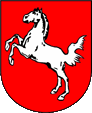
bis 1946,
Wappen der Provinz Westfalen,
Quelle, nach: Deutsche Wappen Rolle
Das weiße Pferd ist das "Sachsenross". Es geht auf das Stammesherzogtum Sachsen zurück, und wurde von den Welfen übernommen, deren Symbol eigentlich ein goldener Löwe auf rotem Grund war. Westfalen gehörte bis zum Jahre 1180 zum Einflussbereich der Welfen. So wurde es zum Wappentier des Königreichs Hannover (ab 1866 preußische Provinz Hannover), der preußischen Provinz Westfalen und ab 1922 des Landes Braunschweig. In der BRD wird diese Tradition fortgesetzt, in dem jene Bundesländer der BRD, zu denen ehemals welfische Gebiete gehören, noch heute das weiße Pferd im Wappen haben: Niedersachsen und Nordrhein-Westfalen. Auf alten Wappendarstellungen (mindestens bis 1935) trägt das Sachsenross den Schweif immer nach oben gerichtet. Mit der Neugründung des Staates Hannover wurde nach dem Zweiten Weltkrieg mit dieser Tradition gebrochen, denn das Sachsenross trug auf dessen Flagge einen eher herabhängenden Schweif. Das wurde für das Land Niedersachsen – dem Nachfolger des Staates Hannover – beibehalten. Daher wird das Sachsenross in Westfalen, wo es den Schweif noch immer noch oben gerichtet trägt, als "Westfalenpferd" bezeichnet, im Gegensatz zum "Niedersachsenpferd".
Quelle: Wikipedia (D),
Deutsche Wappen Rolle,
Volker Preuß
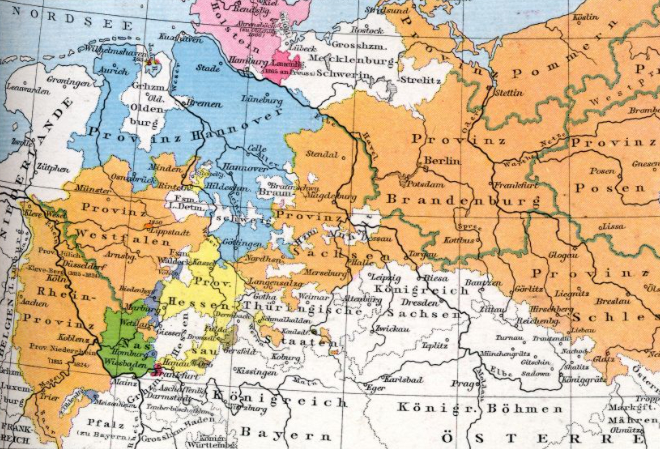
Quelle: Professor G. Droysens Allgemeiner Historischer Handatlas, 1886
Die historische Landkarte von 1866 zeigt die Provinz Westfalen im Westen.
Fläche: 20.217 km²
Einwohner: 4.811.000 (1925)
Bevölkerungsdichte: 238 Ew./km²
Hauptstadt: Münster
Quelle: www.gonschior.de
seit 8. Jahrhundert · eine der drei sächsischen Stammesprovinzen
1180 · Schaffung Herzogtums Westfalen durch Kaiser Friedrich I. Barbarossa
1180–1793 · zum späteren Kurfürstentum und Erzbistum Köln
1807–1813 · Königreich Westfalen
1815 · Bildung der preußischen Provinz Westfalen aus
- dem alten Westfalen
- der Grafschaft Sayn-Wittgenstein
- der Abtei Essen
1945 · Besetzung durch alliierte Truppen, britische Besatzungszone
1946 · Schaffung des Landes Nordrhein-Westfalen durch Vereinigung der Provinz Westfalen mit dem Nordteil der Rheinprovinz und dem Land Lippe-Detmold
Quelle: Atlas zur Geschichte,
Wikipedia (D),
Discovery '97
Der Landschaftsname "Falen" ist germanischen Ursprungs. Er geht auf das althochdeutsche Wort "falaho" zurück, was "Flachlandbewohner" heißt. Es war aber auch die Bezeichnung für die Ebene, die durch den Fluss Weser in Ostfalen und Westfalen geteilt wurde. nach der Niederlage der Sachsen gegen Karl des Großen im Jahre 785 wurde Sachsen an das Frankenreich angeschlossen und in drei Stammesprovinzen aufgeteilt. "Westfalen", "Ostfalen" und dazwischen "Engern". Sie wurden später auch eigene Herzogtümer. Das von Napoléon 1807 geschaffene Königreich Westphalen (französisch: Royaume de Westphalie) hat damit nichts zu tun. Offenbar war nur der Name ausgeliehen. Um Verwechslungen mit dem historischen "Westfalen" zu vermeiden, wird Napoléons Kreation heute allgemein "Westphalen" geschrieben.
Quelle: Wikipedia (D),
Volker Preuß,
Handbuch der geographischen Namen




Mit freundlicher Untersützung von: A. Kortmann (D)