mobile Ansicht, to the English Version tap the flag

- Autonome Territoriale Einheit Gagausien
- seit 1994 Autonomie innerhalb von Moldawien
- Eigenbezeichnung, Gagausisch: Avtonom Territorial Bölümlüü Gagauz Yeri
• Flagge
• historische Flaggen
• Bedeutung/Ursprung der Flagge
• Wappen
• Landkarte
• Zahlen und Fakten
• Geschichte
• Ursprung des Landesnamens
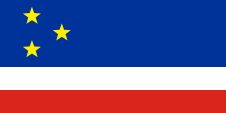
Nationalflagge,
Seitenverhältnis = 1:2,
Quelle, nach:
Flags of the World


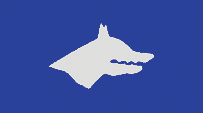
11.Jhd.–13.Jhd.,
Flagge des Kumanischen Reiches

1990–1995,
Nationalflagge,
Seitenverhältnis = 1:2,
Quelle, nach:
UNPO
Die heutige Flagge Gagausiens wurde am 31.10.1995 offiziell angenommen. Sie zeigt drei horizontale Streifen in Blau, Weiß und Rot im Verhältnis 3:1:1. Blau ist die traditionelle Farbe der Turkvölker – geht wahrscheinlich auf Timur Lenk zurück – und steht für den Himmel und Hoffnung und die Liebe zur Heimat. Das Weiß symbolisiert traditionell den Westen, den Lebensraum der Gagausen, steht aber auch für Friedfertigkeit. Das Rot steht für Mut und Ausdauer im Kampf für die Freiheit. Die drei Sterne symbolisieren Vergangenheit, Gegenwart und Zukunft. Die vorherige, inoffizielle Flagge von Gagausien ging auf die Flagge des Kumanischen Reiches (1061–1240) zurück, und zeigte den Kopf eines Wolfs. Es waren auch andere Varianten der Flagge bekannt.
Quelle:
Wikipedia (DE),
Flags of the World
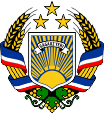
Wappen von Gagausien,
Quelle, nach:
Wikipedia (DE)
Lage innerhalb Moldawiens:

Quelle/Source: Moldova_location_map.svg: NordNordWestderivative work:
Xfigpower (pssst), CC BY-SA 3.0, via Wikimedia Commons
Fläche: 1.832 km²
Einwohner: 134.535 (2014), davon 82% Gagausen, 5% Bulgaren, 5% Moldauer, 4% Russen, 3% Ukrainer
Religionen: größtenteils orthodoxe Christen
Bevölkerungsdichte: 73 Ew./km²
Hauptstadt: Comrat, 26.000 Ew. (2014)
Amtssprachen: Gagausisch (Türkisch), Moldawisch (Rumänisch) und Russisch
sonstige Sprachen: Bulgarisch, Ukrainisch
Währung: 1 Moldauischer Leu (MDL) = 100 Bani
Zeitzone: MEZ + 1 h
Quelle: Wikipedia (DE)
6. Jhd. · das Gebiet des heutigen Gagausien wird von Slawen besiedelt
ca. 1050 · Eindringen der Kumanen (auch Kun, Kiptschak oder Polowzer genannt, die Vorfahren der heutigen Gagausen)
1061–1240 · das Gebiet des heutigen Gagausien gehört zum Kumanischen Reich
1240 · das Kumanische Reich wird von den Mongolen zerstört, nach Abzug der Mongolen (etwa 1280) entsteht zwischen den Karpaten und dem Dnestr das Fürstentum Moldau
1455 · das Fürstentum Moldau wird dem Osmanischen Reich tributpflichtig
1484 · der Süden von Moldau, das Gebiet der Gagausen, wird vom Osmanischen Reich als Provinz Butscha annektiert
1511 · das Fürstentum Moldau wird zu einem osmanischen Vasallenstaat
1806 · Russland besetzt im Krimkrieg den osmanischen Vasallenstaat Moldau und das Gebiet Butscha
1812 · Russland teilt Moldau und Butscha: die Gebiete zwischen Prut und Dnestr werden als Bessarabien (später Moldawien genannt) von Russland anektiert, und damit auch das Gebiet der Gagausen im Süden des Landes
1856 · Gagausien kommt unter moldauisch-rumänische Herrschaft
1878 · Gagausien wird wieder russisch
1918 · Rumänien annektiert Bessarabien (und damit Gagausien)
1924 · auf Ukrainischem Gebiet, östlich des Dnestr, wird die Moldawische Autonome Sozialistische Sowjetrepublik gegründet (Transnistrien)
1940 · Rumänien tritt Bessarabien (und damit Gagausien) an die UdSSR ab, Vereinigung Bessarabiens und der Moldauischen ASSR zur Moldauischen SSR (heutiges Moldawien)
1941–1945 · Annexion Moldawiens (und damit Gagausiens) durch Rumänien
1945 · Moldawien (und damit Gagausien) kommt wieder als Moldawische SSR zur UdSSR
1980 · Beginn des Freiheitskampfes der Gagausen
1989 · die Gagausen werden durch Sprachgesetze in Moldawien diskriminiert
1990 · Ausrufung der unabhängigen Republik Gagausien
1994 · Anerkennung der Republik Gagausien als autonome Republik innerhalb Moldawiens
1995 · Wahlen zur Nationalversammlung von Gagausien, offizielles Ende des fünfjährigen Konfliktes zwischen Gagausien und Moldawien
2014 · Referendum in Gagausien, 70 % Beteiligung, Ergebnis: 98,4 % für engere Beziehungen mit Russland, 97,2 % gegen Annäherung an die EU
2014 · der moldauische Ex-Präsident fordert ein Referendum in Moldawien über die Abschaffung der Autonomie Gagausiens
Quelle: Wikipedia (DE),
Atlas zur Geschichte,
Weltgeschichte
Der Name des Landes "Gagausien" geht auf das hier lebende Volk der Gagausen zurück. Die Vorfahren der Gagausen, die Kumanen (auch Kun, Kiptschak oder Polowzer genannt), wanderten im 11. Jahrhundert in der Region ein. Das Wort "Gagauz" geht auf das türkische Wort "Gökoğuz" zurück. "Gök" heißt Himmel "Oğuz" heißt "Oghuse". Oghusen ist eine Bezeichnung für tatarische Stämme. Nach der Mongoleninvasion wurde für diese Stämme die Bezeichnung "Türkmen" verwendet.
Quelle: Wikipedia (DE),
Die Völker der Erde