hier klicken → Tamil Eelam
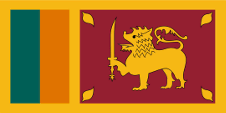
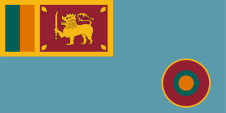
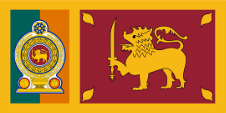
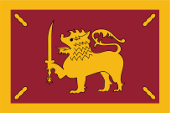
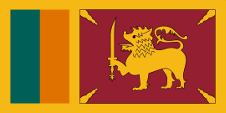
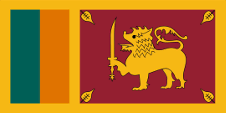
Die heutige Flagge Sri Lankas wurde offiziell am 22.05.1972 eingeführt und am 07.09.1978 in den Ecken des dunkelroten Feldes noch mal ein klein wenig verändert. Sie zeigt innerhalb eines gelben Rahmens ein großes braunes Feld auf der rechten Seite, und links – in einem kleineren Feld – zwei senkrechte Streifen in Grün und Safran-Gelb. Innerhalb des dunkelroten Feldes ist ein gelber schwerttragender Löwe zu sehen, und in den Ecken gelbe Blätter des Bo-Baumes. Das große rechte Feld entspricht der Flagge des alten singhalesischen Königreiches von Kandy (Königreich Udarata) mit dem Königsemblem des Goldenen Löwen. Gelb ist die Farbe des Buddhismus. Der gelbe Rahmen um die Flagge symbolisiert den Schutz des Landes durch diese Religion. Der grüne Streifen steht für die moslemische Minderheit des Landes, und der safran-gelbe für die hinduistische Minderheit der Tamilen. Die Farben der Flagge sind definiert und niedergelegt in einem Dokument der Sri Lanka Standards Institution (SLSI), wahrscheinlich von 2020, unter anderem auch im Farbraum RGB, Gelb 247-183-24, Bordeaux-Rot 148-30-50, Orange 223-117-0 und Grün 0-95-86, was in etwa folgenden Pantone-Farbwerten entsprechen würde: Gelb = 1235 C, Bourdeaux-Rot = 194 C, Orange = 716 C und Grün = 3292 C. Vor dieser Farbfestlegung wurden die Farben der Flagge recht willkürlich wiedergegeben, so das sie in der Praxis, als Flaggen, auf Webseiten oder in der Fachliteratur, immer recht unterschiedlich wiedergegeben worden waren. Hin und wieder soll es auch offizielle Regelungen gegeben haben, so z.B. 1978, als das braune Feld in Richtung Rotbraun umgefärbt worden sein soll.
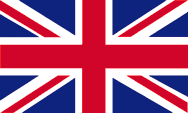
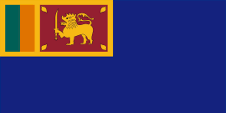
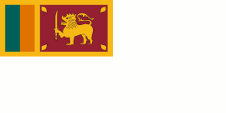
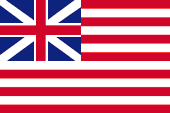
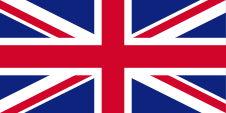
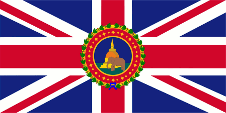
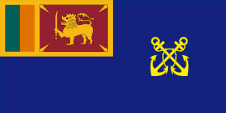
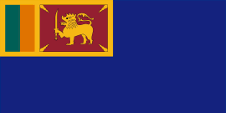
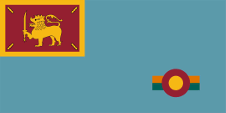
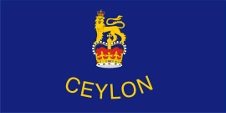
Sri Lanka orientiert sich am britschen Ensign-System. Das weißt auf die früheren Verbindungen zu Großbritannien hin. Ceylon wurde 1802 eine britische Kronkolonie, die Flagge Großbritanniens wurde gehisst, das Land wurde Teil des United Kingdom, erhielt eine eigene Verwaltung und einen eigenen Gouverneur. An Land, bis 1864 auch zur See, repräsentierten der einzelne Bürger und auch die Behörden ihren Status als Bürger oder Organe des United Kingdom, durch die Verwendung des Union Jack, dann "Union Flag" genannt.
Großbritannien hatte in Jahr 1864 ein Flaggensystem eingeführt, in dem:
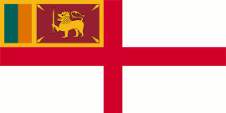
• Kriegsschiffe einen sogenannten "White Ensign" (Marineflagge), eine weiße Flagge oft mit durchgehendem roten Georgskreuz und mit dem Union Jack in der Oberecke,
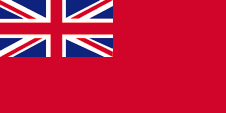
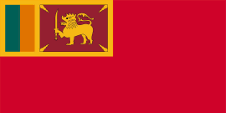
• Handelsschiffe einen "Red Ensign" (auch "Civil Ensign" → Bürgerflagge genannt, die eigentl. Handelsflagge), eine rote Flagge mit dem Union Jack in der Oberecke, und
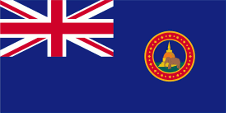
• Dienstschiffe einen "Blue Ensign" (Regierungsflagge → die eigentliche Staatsflagge), eine blaue Flagge mit dem Union Jack in der Oberecke führten.
Seit 1865 durften Schiffe von Kolonialregierungen einen Blue Ensign mit einem Badge (Abzeichen) im fliegenden Ende führen. Für alle anderen Zwecke war ab diesem Zeitpunkt an Land ausschließlich der britische Union Jack zu verwenden und zur See die übliche rote britische Handelsflagge, der "Red Ensign". Das Badge von Ceylon war eine blaue Scheibe mit einem golden verzierten, roten Rand. Auf der Scheibe eine Szenerie mit einem Elefanten vor einer buddhistischen Pagode.
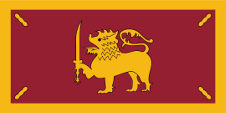
Sri Lanka wurde am 04.02.1948 unabhängig, verblieb jedoch im British Commonwealth of Nations, mit dem britischen Monarchen als Staatsoberhaupt und die erste Flagge des unabhängigen Ceylon wurde eingeführt. Sie entsprach der Flagge des alten Königreiches von Kandy, dass den Europäern bis zuletzt Widerstand geleistet hatte. Die nichtbuddhistische (Moslems) und nichtsinghalesische (Tamilen) Bevölkerung akzeptierte diese Flagge nicht. Sie wurde daher am 02.03.1951 durch Hinzufügen eines grünen und safran-gelben Streifens in ihre heutige Form abgeändert. Am 22.05.1972 wurde Ceylon eine Republik, einige Flaggen in der britischen Tradition wurden verändert oder abgeschafft. So wurde das Georgskreuz 1972 von der der Marineflagge entfernt. Wahrscheinlich wurden – wenn auch nicht sofort – der Blue Ensign als Staatsflagge und der Red Ensign als Handelsflagge abgeschafft, neben einigen anderen Veränderungen an weiteren Flaggen. So wurde auch ein Detail der Nationalflagge geändert: Die bis dahin in den vier Ecken des dunkelroten Feldes gezeigten Dachspitzen einer Pagode (nach anderen Quellen "altceylonesische Pfähle") wurden durch Blätter des Bo-Baumes ersetzt. Der Bo(dhi)-Baum (auch Pipul-Baum oder Pippala-Baum) ist der Baum, unter dem Buddha die Erleuchtung empfing. Es herrscht jedoch eine gewisse Unklarheit darüber, ob der Blue Ensign (Staatsflagge) und der Red Ensign (Handelsflagge) wirklich abgeschafft worden sind. Verbindliche Informationen dazu gibt es nicht. Viele Quellen führen zumindest die rote Handelsflagge noch immer an. Trotz aller Emanzipation orientiert sich Sri Lanka mit seinen heutigen Flaggen noch immer am britischen Ensign-System. Im Zusammenhang mit der Annahme einer neuen Verfassung wurde die Form der Bo-Blätter im Jahre 1978 leicht verändert. Jeder Präsident Sri Lankas hat seine eigene, persönliche Flagge, die individuell gestaltet ist.
Quelle:
Die Welt der Flaggen,
Flags of the World,
Wikipedia (EN),
Wikipedia (DE),
World Statesmen,
Volker Preuß
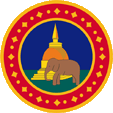
1875–1948,
Emblem (Badge) von Britisch Ceylon,
Quelle, nach: Flaggenbuch 1939
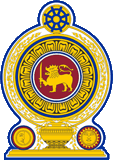
seit 1972,
Wappen von Sri Lanka,
Quelle, nach: Corel Draw 4
Das heutige Staatswappen wurde 1972 angenommen. Bis dahin wurde ein ähnliches Emblem aus dem Jahre 1948 verwendet. Das Wappen zeigt innerhalb eines "Palapeti Vitaya" genannten Ähren- und Lotuskranzes eine golden umrandete dunkelrote Scheibe mit dem schwerttragenden Löwen von Kandy. Darunter die Tasse "Punkalasa" zwischen Mond und Sonne. Das Wappen ist bekrönt vom buddhistischen Gesetzesrad, dem "Dschammatschakra".
Quelle: Flaggen Wappen Hymnen
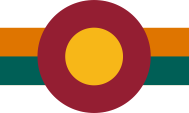
1951–2010,
Flugzeugkokarde,
Quelle, nach: Wikipedia (EN)
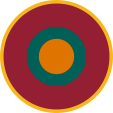
seit/from 2010,
Flugzeugkokarde,
Quelle, nach: Wikipedia (EN)
Lage:
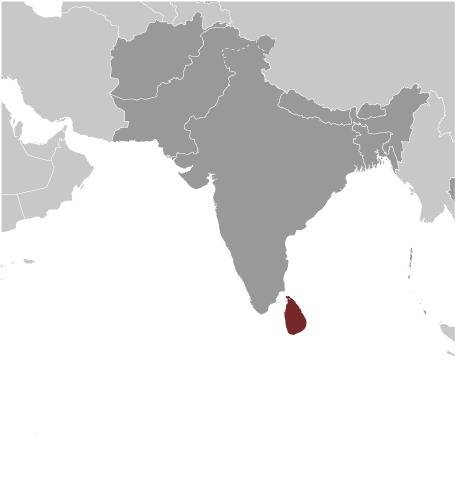
Quelle/Source: CIA World Factbook
Landkarte des Landes:
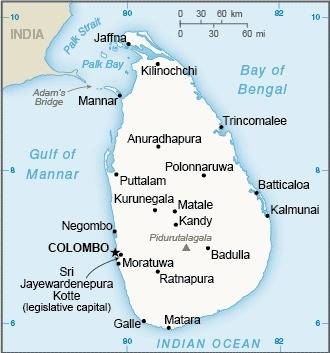
Quelle/Source: CIA World Factbook
Fläche: 65.610 km²
Einwohner: 22.000.000 (2023), davon 75% Singhalesen, 11% Tamilen, 9% Moors (Araber), 0.2% Burgher (Nachkommen von Portugiesen und Niederländern), 0,2% Malaien
Religionen: 70% Buddhisten, 13% Hindus, 10% Moslems, 6% Katholiken, 1% Protestanten
Bevölkerungsdichte: 335 Ew./km²
Hauptstadt: Colombo, 752.993 Ew. (2011)
Regierungssitz: Kotte, 107.925 Ew. (2012)
Amtssprachen: Singhalesisch, Tamilisch
sonstige Sprachen: Englisch
Währung: 1 Sri-Lanka-Rupie (LKR, SLR) = 100 Sri-Lanka-Cents
Zeitzone: MEZ + 4,5 h
Quelle:
Wikipedia (D)
Antike · die Insel Ceylon ist bei den Römern als Taprobane bekannt, im buddhistischen Indien wird sie später Sihaladipa genannt
6. Jahrhundert v.Chr. · Singhalesen aus Indien erobern Ceylon, Abdrängen der Wedda-Urbevölkerung
3. Jahrhundert v.Chr. · Beginn der Einwanderung von Tamilen aus Indien, später auch regelrechte Invasionen
247 v.Chr. · Einführung des Buddhismus
10.–15. Jahrhundert n.Chr. · im Norden Ceylons bilden sich tamilische Königreiche
15. Jahrhundert n.Chr. · im Süden entsteht das singhalesische Königreich Kandy (Königreich Udarata)
15.11.1505 · der portugiesische Seefahrer Lourenço de Almeida landet in Ceylon (Singhalesisches Königreich Kotte), und unterstellt es portugiesischer Oberhoheit, Bau der Festung Colombo
1518 · die Portugiesen ernennen Colombo zur Hauptstadt des Königreichs Kotte
27.05.1597 · der König von Kotte stirbt ohne Nachkommen, das Erbe geht an den König von Portugal
1619 · die Portugiesen erobern Jaffna im Norden und beherrschen nun ganz Ceylon (Ceilão), die Insel wird von Goa in Indien aus verwaltet
1639–1640 · die Niederländer landen im Osten und Süden der Insel und errichten im Auftrag der Niederländischen Ostindienkompanie Stützpunkte (Trincomalee, Batticaloa, Galle), und stoßen später allmählich in Richtung Colombo vor
1656 · die Niederländer erobern Colombo, die Portugiesen ziehen sich nach Jaffna zurück
1658 · die Niederländer erobern Jaffna und beherrschen nun fast ganz Ceylon (außer das Königreich Kandy im zentralen Bergland)
1765 · die Niederländer beherrschen kurzzeitig das Königreich Kandy
1782 · die Briten beherrschen Trincomalee
1782–1784 · die Franzosen beherrschen Trincomalee
1795 · die Britische Ostindienkompanie landet im Osten und Norden der Insel und erobert Trincomalee, Batticaloa und Jaffna
1796 · die Britisch Ostindische Kompanie erobert Colombo und beherrscht nun ganz Ceylon (außer das Königreich Kandy im Mittleren Bergland), die Insel wird von Madras in Indien aus verwaltet
1802 · Ceylon wird Britische Kronkolonie
1815–1817 · das Königreich Kandy wird erobert, und bis zum Oktober 1818 der Britischen Kronkolonie Ceylon angeschlossen
04.02.1948 · Großbritannien gewährt Ceylon die Unabhängigkeit, Ceylon verbleibt im British Commonwealth of Nations
1955 · Ceylon wird Mitglied der UNO
22.05.1972 · Ceylon wird Republik, Proklamation der Republik Sri Lanka
07.09.1978 · neue Verfassung, Demokratische Sozialistische Republik Sri Lanka
1983–1987 · Bürgerkrieg zwischen Tamilen und Singhalesen, die Tamilen fordern die Unabhängigkeit für einen Tamilenstaat "Tamil Eelam"
1987 · Friedensabkommen zwischen der Regierung Sri Lankas und der Tamilischen LTTE-Miliz, Indische Truppen überwachen den Frieden (LTTE = Liberation Tigers of Tamil Eelam)
1988 · die Tamilischen Milizen greifen die Indischen Truppen an
1990 · die Indischen Truppen verlassen die Insel
1990–1995 · Bürgerkrieg zwischen Regierungstruppen und Tamilen, Jaffna (die Hauptstadt der Tamilen) wird durch erobert, die LTTE-Miliz verzichtet auf die Forderung nach Autonomiegebieten
1996 · Fortsetzung der Kämpfe zwischen Regierungstruppen und Tamilen
2009 · vollständiger militärischen Sieg der sri-lankischen Regierungstruppen über die LTTE-Miliz, Ende des bewaffneten Tamilischen Separatismus
Quelle: Atlas zur Geschichte,
World Statesmen,
Wikipedia (EN),
Volker Preuß
Die Insel Ceylon trug unterschiedlichste Namen und wurde von verschiedenen Völkern benamt. Die Römer nannten sie "Taprobane". In der buddhistischen Religionssprache Pali wurde sie "Sihaladipa" genannt, von den Hindus "Sinhala" (Reich der Löwen) und den Arabern "Serendib" (Löweninsel). Der Name "Ceylon" ist europäischen Ursprungs und entstand wahrscheinlich durch Veränderung des Hindi-Wortes "Sinhala" zur portugiesischen Bezeichnung "Ceilão". Die Niederländer und Briten nannten sie schließlich "Ceylon". Die seit 1972 verwendete Bezeichnung "Sri Lanka" für den Staat auf der Insel Ceylon ist Singhalesischen Ursprungs (Tamil: "Ilankai") und heißt "strahlend schönes Land".
Quelle: Wikipedia (DE), Handbuch der geographischen Namen