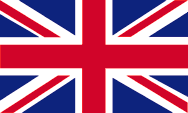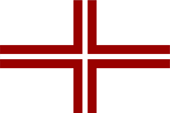
Marineflagge,
Seitenverhältnis = 2:3,
Quelle, nach:
Wikipedia (D)

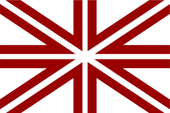
Gösch,
Seitenverhältnis = 2:3,
Quelle, nach:
Wikipedia (D)
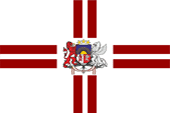
Flagge des Präsidenten,
Seitenverhältnis = 2:3,
Quelle, nach:
Wikipedia (D)

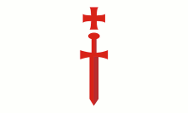
1230–1237,
Flagge des Schwertbrüderordens,
Quelle, nach:
Wikipedia (EN)

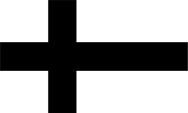
1237–1561,
Flagge des Deutschen Ordens,
Quelle, nach:
Flags of the World
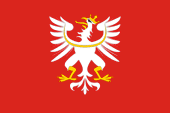
1595–1621,
Flagge des Königreichs Polen,
Quelle, nach:
Wikipedia (PL)
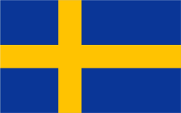
1621–1721,
Flagge von Schweden,
Quelle, nach:
Wikipedia (D)


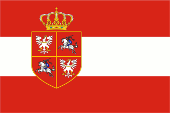
1721–1795,
Flagge des Königreichs Polen-Litauen,
Quelle, nach:
Flags of the World
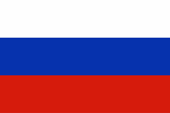
1795–1858,
Nationalflagge von Russland,
Quelle, nach:
Flags of the World
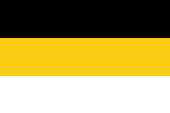
1858–1915,
Nationalflagge von Russland,
Quelle, nach:
Flags of the World
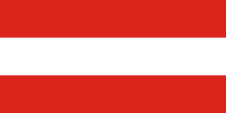
ca.1870-1916,
inoffizielle Nationalflagge,
Quelle, nach:
Flaggen und Wappen der Welt
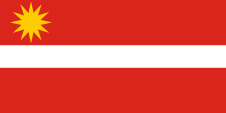
1916,
inoffizielle Nationalflagge,
Quelle, nach:
Wikipedia (D)
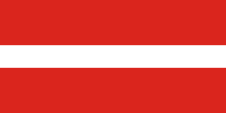
1916–1917,
inoffizielle Nationalflagge,
Quelle, nach:
Flaggen und Wappen der Welt
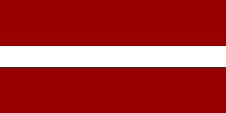
1918–1940,
Nationalflagge,
Quelle, nach: Flaggenbuch 1939
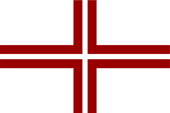
1918–1940,
Marineflagge,
Quelle, nach: Flaggenbuch 1939
1918–1940,
Gösch,
Quelle, nach: Flaggenbuch 1939
Lotsen(ruf)flagge,
Seitenverhältnis = 2:3,
Quelle, nach:
Flaggenbuch 1939
Diese Art Flaggen wurde im 20. Jahrhundert abgeschafft, heute gilt:
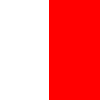 Lotse an Bord
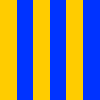 Erbitte Lotse
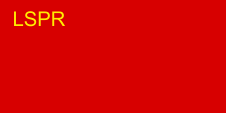
1918–1920,
Flagge der Lettischen Sozialistischen Sowjetrepublik,
Seitenverhältnis = 1:2,
Quelle, nach: World Statesmen
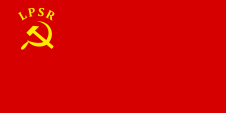
1940–1953,
Flagge der Lettischen Sozialistischen Sowjetrepublik,
Seitenverhältnis = 1:2,
Quelle, nach: World Statesmen
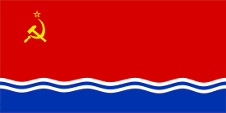
1953–07.10.1988 Flagge der Lettischen Sozialistischen Sowjetrepublik,
07.10.1988–20.02.1990 Staatsflagge,
Seitenverhältnis = 1:2,
Quelle, nach:
Wikipedia (D)
Die Flagge Lettlands zeigt einen schmalen weißen Streifen in der Mitte eines karminroten Flaggentuches (Pantone 201 C), so dass drei horizontale Streifen im Verhältnis 2:1:2 entstehen. Das Rot steht für das Blut, das für das Erreichen der Selbständigkeit in der Vergangenheit vergossen wurde. Das Weiß steht für das Recht, die Gerechtigkeit, die Wahrheit und die Ehre des Volkes.
Eine rote Flagge mit einem weißen Streifen hat in Lettland eine sehr lange Tradition. Eine solche Flagge wurde bereits im 13. Jhd. erstmals erwähnt. Die Livländische Reimchronik aus dem 14. Jahrhundert berichtet über ein Gefecht im Jahre 1279 in welchem Lettische Stämme aus der Gegend von Wenden (Cesis) eine solche Flagge bei sich trugen.
Eine Legende besagt, dass ein tödlich verwundeter Häuptling der Letten auf ein weißes Laken gebettet worden war. Dort wo er lag bliebt das Laken weiß, jedoch links und rechts von ihm wurde das Laken von seinem Blut getränkt. Ab dem nächsten Gefecht, dass wie alle folgenden siegreich verlief, wurde das Laken als Flagge benutzt, und von allen Lettischen Stämmen als Flagge akzeptiert.
Als Flagge des Volkes tauchte sie über die Jahrhunderte immer wieder auf, zuletzt 1915, während des Ersten Weltkriegs. Im Zusammenhang mit der sich ankündigenden Unabhängigkeit des Landes sollte diese Flagge die Nationalflagge werden, jedoch gab es Bedenken, das die Flagge mit derjenigen von Österreich verwechselt werden könnte. So hat der lettische Künstler Ansis Cirulis im Mai des Jahres 1917 vorgeschlagen Karmesinrot anstelle von normalem Rot zu verwenden. Diese Flagge wurde am 18.11.1918 offiziell für Lettland angenommen. Beschlüsse des Parlaments bestätigten das am 15.06.1921 und offenbar noch einmal am 20.01.1923.
Diese Flagge wurde am 07.10.1988 als Nationalflagge und am 20.02.1990 auch als Staatsflagge wieder eingeführt. Die tiefrote Farbe soll angeblich auf charakteristische, landestypische Färbemittel zurückgehen.
Zwischen 1940 und 1941, sowie 1944 und 1953 verwendete Lettland, als Lettische Sozialistische Sowjetrepublik und Teil der Sowjetunion, ein sowjetisches Einheits-Modell. Am 17.01.1953 wurde eine neue Sowjetflagge für Lettland angenommen. Es war ein Entwurf von dem Maler Arturs Lapinsch. Logischerweise zeigte diese Flagge wieder Stern, Hammer und Sichel in Gold auf rotem Grund, am unteren Ende der Flagge jedoch ein dunkelblauer Streifen, vom roten Feld durch eine Wellenline getrennt. Ab dem 07.10.1988 war sie nur noch als Staatsflagge gültig, und wurde am 20.02.1990 endgültig abgeschafft.
Quelle:
Jürgen Kaltschmitt,
Volker Preuß,
Wikipedia (EN),
Wikipedia (D),
FOTW
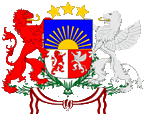
Wappen von Lettland,
Quelle:
Corel Draw 4
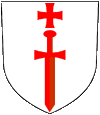
1230–1237,
Wappenschild des Schwertbrüderordens
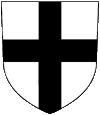
1237–1561,
Wappenschild des Deutschen Ordens
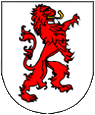
Wappen von Kurland
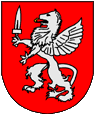
Wappen von Livland
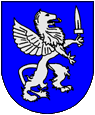
Wappen von Lettgallen
Das lettische Staatswappen wurde von Rihards Zarins geschaffen und im Jahre 1921 eingeführt. Es war bis zur Machtübernahme durch die Bolschewisten im Jahre 1940 gültig, und wurde unter deren Herrschaft durch ein sowjetisches Modell ersetzt. Im Zusammenhang mit dem Erreichen der Unabhängigkeit von der Sowjetunion wurde das Wappen von 1921 am 27.02.1990 wieder eingeführt.
Es zeigt einen geteilten und halbgespaltenen Schild. In der oben Hälfte eine goldene, aufgehende Sonne mit siebzehn Strahlen auf blauem Grund. Es ist ein Symbol für ganz Lettland und seine siebzehn Landkreise. Im Feld unten links ein roter Löwe auf Silber. Es steht für die Landschaften Kurland und Semgallen. Im Feld unten rechts ein silbernes Fabeltier (Greif) mit einem Schwert auf Rot. Es steht für die Landschaften Livland und Lettgallen. Oberhalb des Schildes befinden sich drei goldene Sterne. Sie stehen für die historischen Landschaften und Landesteile Lettlands: das Herzogtum Kurland, Livland und die Landschaft Lettgallen. Schildhalter sind der rote Löwe und der silberne Greif aus dem Schild. Sie stehen auf Eichenzweigen. Unterhalb ein Band in den Landesfarben.
Während des Zweiten Weltkriegs, in der Zeit der deutschen Besetzung zwischen 1941 und 1944 hatte Lettland offiziell keine eigenen Hoheitszeichen. Es gehörte zum Reichskommissariat Ostland, in dem die Staaten den Baltikums und Teile des heutigen Nordwestens von Weißrussland zusammengefasst waren. Die Lettische Legion, die im Zweiten Weltkrieg freiwillig an der Seite des Deutschen Reiches gegen die Sowjetunion kämpfte trug als Ärmelabzeichen einen roten Schild mit einem schmalen weißen Diagonalstreifen.
Quelle:
Wikipedia (D),
Flaggen und Wappen der Welt,
Nationalflaggen der Welt,
Avantgarde für Europa

Flugzeugkokarde,
Quelle, nach: Wikipedia (EN)
1918–1940,
Flugzeugkokarde,
Quelle, nach: Wikipedia (EN)
1993–2000,
Flugzeugkokarde der Nationalgarde ,
Quelle, nach: Wikipedia (EN)
Lage:
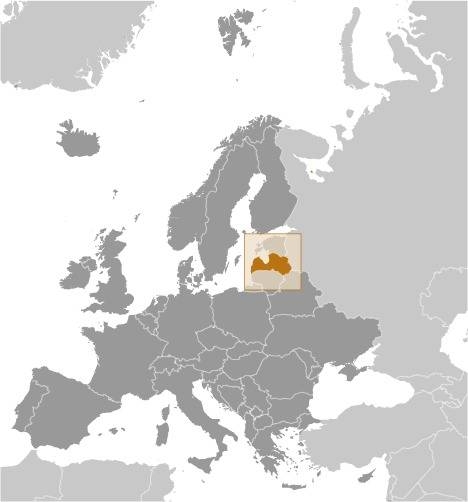
Quelle/Source: CIA World Factbook
Landkarte des Landes:
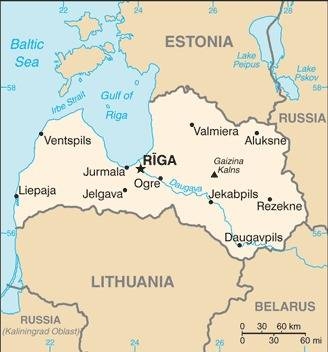
Quelle/Source: CIA World Factbook
Landkarte des Baltikums:
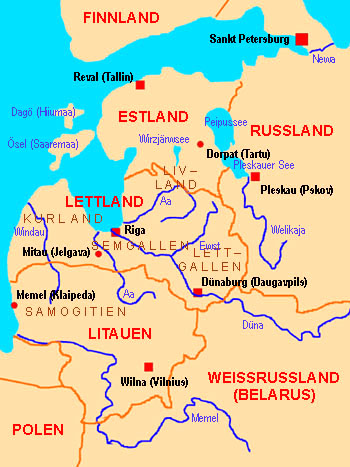
Quelle/Source: Volker Preuß
Fläche: 64.589 km²
Einwohner: 1.900.000 (2020), davon 62% Letten, 26% Russen, 3% Weißrussen, 2% Ukrainer, 2% Polen, 1,2 % Litauer, 0,1% Deutsche
Religionen: 21% Katholiken, 21% Russisch-Orthodoxe, 13% Protestanten, 0,5% Juden, 0,4% Heidnisch-Religiöse, 0,3% Moslems, 40% Nicht-Religiöse
Bevölkerungsdichte: 29 Ew./km²
Hauptstadt: Riga, 627.487 Ew. (2020)
Amtssprache: Lettisch
sonstige Sprachen: Russisch, Lettgallisch
Währung: 1 Euro (EUR, €) = 100 Cent (bis zum 31.12.2013: 1 Lat = 100 Santims)
Zeitzone: MEZ + 1 h
Quelle: Wikipedia (D)
9. Jhd. · Besiedlung durch die ostbaltischen Stämme der Lettgallen, Selonen, Semgallen, Kuren und Liven
1202 · Gründung des "Schwertbrüderordens" in Dünamünde
1230 · Eroberung Kurlands, Livlands, Lettgallens und Semgallens durch den Schwertbrüderorden
1236 · Niederlage des Schwertbrüderordens gegen die Litauer
1237 · Vereinigung des Schwertbrüderordens mit dem Deutschen Orden, Kurland, Livland, Lettgallen und Semgallen kommen als Livländischer Bund mit einem eigenen Ordensmeister an den Staat des Deutschen Ordens
1346 · Estland wird durch den Deutschen Orden von Dänemark abgekauft und dem Livländischen Bund des Deutschen Ordens angegliedert
1558–1595 · Livländischer Krieg, der livländische Ordensmeister des Deutschen Ordens wandelt Kurland und Semgallen in ein Herzogtum als polnisches Lehen um, Estland musste an Schweden und teilweise an Dänemark abgetreten werden, Livland und Lettgallen kamen direkt an Polen
1621 · Schweden erobert Livland
1629 · Livland kommt offiziell an Schweden
1710 · Nordischer Krieg, Russland erobert Livland
1721 · Frieden von Nystad, Livland und Estland kommen an Russland, Kurland, Semgallen und Lettgallen bleiben bei Polen
1795 · Aufteilung Polens → Kurland, Semgallen und Lettgallen kommen zu Russland
19. Jhd. · Entstehen der lettischen Nationalbewegung
1914–1918 · Erster Weltkrieg: 1915 das Deutsche Reich erobert Kurland und Semgallen, 1918 das Deutsche Reich erobert Lettgallen und Livland
07.11.1917 · bolschewistische Revolution in Russland, Machtergreifung durch die Sowjets
03.03.1918 · Sowjetrussland kapituliert gegenüber dem Deutschen Reich, Friedensvertrag von Brest-Litovsk, Herausbildung eines lettischen Staates (einschließlich Kurland, Semgallen, Lettgallen und dem Süden Livlands)
18.11.1918 · Lettland erklärt seine Unabhängigkeit von Sowjetrussland, Proklamation der Republik Lettland, Proklamation der Lettischen Sozialistischen Sowjetrepublik, Bürgerkrieg bis 1920
18.03.1921 · Friede von Riga, Sowjetrussland erkennt die Unabhängigkeit Lettlands an
1934 · Errichtung der Präsidialdiktatur durch K. Ulmanis
23.08.1939 · deutsch-sowjetischer Nichtangriffspakt, Lettland wird sowjetische Interessensphäre und von der Sowjetunion besetzt
12.07.1940 · Proklamation der Lettischen Sozialistischen Sowjetrepublik (LSSR)
05.08.1940 · Aufnahme der LSSR in die Sowjetunion, Deportation von Tausenden von Einwohnern nach Sibirien
1939–1945 · Zweiter Weltkrieg: Juni/Juli 1941 Eroberung Lettlands durch deutsche Truppen, Lettland kommt zum Reichskommissariat Ostland, 36.000 Letten kämpfen freiwillig in einer Lettischen Legion an der Seite des Deutschen Reiches gegen die Sowjetunion, Dezember 1944 Eroberung Lettlands (außer Kurland) durch sowjetische Truppen, 09.05.1945 die deutschen Truppen in Kurland kapitulieren, Lettland wird wieder LSSR und wird der Sowjetunion wieder angegeliedert, gewaltsame Russifizierung, Deportation von Tausenden von Letten nach Sibirien
1988 · Gründung der "Lettischen Volksfront“
29.07.1989 · Unabhängigkeitserklärung
04.05.1990 · Proklamation der Republik Lettland
06.09.1991 · die Sowjetunion erkennt die Unabhängigkeit Lettlands an
1993 · erste Freie Wahlen
1994 · Abzug der russischen Truppen
März 2004 · Lettland wird Mitglied der NATO
Mai 2004 · Lettland wird Mitglied der Europäischen Union
Quelle:
Atlas zur Geschichte,
Wikipedia (D),
Discovery '97
Die Bezeichnung "Lettland" ist erst mit der Entstehung der lettischen Nationalbewegung und der Lösung von der russischen Herrschaft aufgekommen. Das Land besteht aus vier historischen Landschaften, welche die Heimat von vier historischen Völkern waren: Kurland (lettisch: Kurzeme), Semgallen (lettisch: Zemgale) Lettgallen (lettisch: Latgale) und Livland (lettisch: Vidzeme). Das Volk der "Letten", welches sich selbst "Latvieschi" nennt, entstand durch die Verschmelzung der Stämme der Lettgaller und der Semgaller. Die Kuren sind in den Letten aufgegangen, und die Liven fast ausgestorben. So kam es, dass die vier Landschaften mehrheitlich von Letten bewohnt waren, und zu einem Lettland vereinigt wurden.
Quelle: Volker Preuß
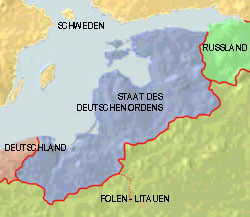
1410–1561
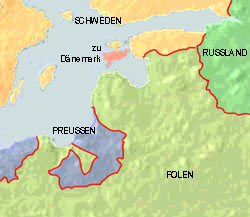
1561–1621
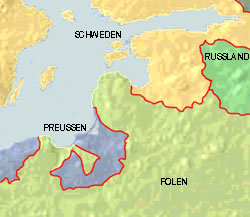
1621–1721
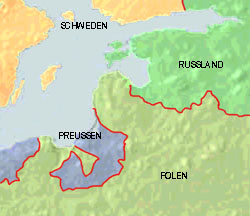
1721–1772
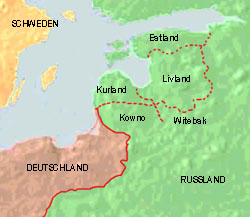
1815–1918
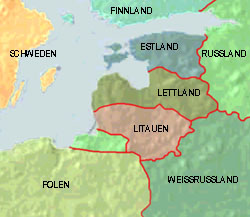
seit 1991
Landkarten: Volker Preuß