mobile Ansicht, to the English Version tap the flag

- Bukowina (Buchenland)
- ehemaliges österreichisches Kronland: Herzogtum Bukowina, in den Ostkarpaten gelegen
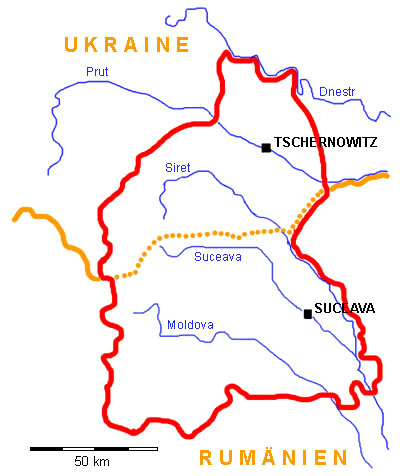
- der Norden der Bukowina gehört heute zur Ukraine, der Süden zu Rumänien
• Flagge
• Bedeutung/Ursprung der Flagge
• Wappen
• Bedeutung/Ursprung des Wappens
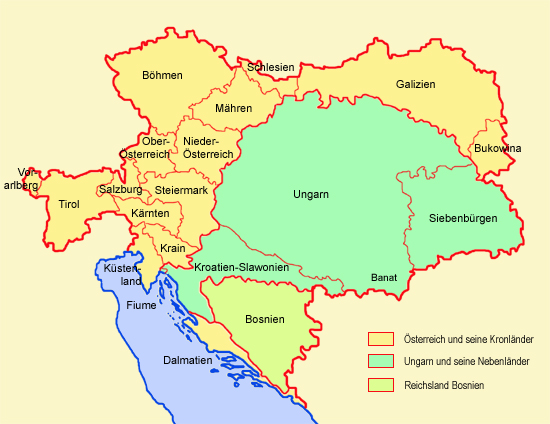
• Landkarte der früheren Kronländer Österreich-Ungarns (bis 1918)
• Landkarte der Bukowina
• Zahlen und Fakten
• Geschichte
• Ursprung des Landesnamens
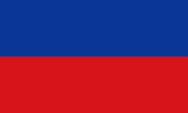
Landesflagge (Landesfarben),
Seitenverhältnis = 2:3,
Quelle, nach:
Flags of the World



In der Zeit der Monarchie hatte das Land, wie alle Kronländer der österreichischen Krone, seine eigenen, sogenannten Landesfarben, die unter anderem auf horizontal getreiften zwei- oder dreistreifigen Flaggen gezeigt wurden. Die Landesfarben waren sehr oft dem jeweiligen Wappen des Kronlandes entnommen oder wurden duch eine weitere, nicht im Wappen enthaltene Farbe ergänzt, oder sie gingen auf ältere Modelle des Landeswappens zurück (z.B. Krain). Offiziell waren die Landesfarben aber nie geregelt oder festgelegt worden, so dass deren Reihenfolge in der Praxis of variierte oder die Farben gar an sich abwichen. Der österreichische Heraldiker Hugo Gerard Ströhl (1851–1919) hat sich wohl als erster des Themas angenommen und wahrscheinlich um das Jahr 1890 herum die Landesfarben auf den Flaggen bei den jeweiligen Landesbehörden abgefragt und zusammengestellt. Für Bukowina wurden Blau und Rot als Landesfarben für das Kronland ermittelt. Das Kronland Herzogtum Bukowina verwendete eine Flagge mit zwei horizontalen Streifen in den Landesfarben Blau und Rot. Die Farben sind die des alten Fürstentums Moldau, zu dem die Bukowina bis 1775 gehörte, und sind dem Wappen entnommen.
Quelle:
Wikipedia (D),
Österreichisch-Ungarische Wappenrolle,
Volker Preuß
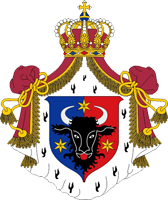
ca.1890–1918,
Wappen Herzogtum Bukowina,
Quelle, nach: Ströhl, Wappenrolle Österreich-Ungarns, 1890, via Wikipedia (D)
Das Wappen der Bukowina geht auf das Wappen des Fürstentums Moldau zurück, und zeigt einen schwarzen Büffelkopf mit roter Zunge und silbernen Hörnern auf einem vertikal geteilten blau-roten Schild und drei goldene sechszackige Sterne. Es wurde am 09.12.1862 verliehen. Die Wappen des Fürstentums Moldau und des russischen Gouvernements Bessarabien waren ähnlich: Das Wappen des Fürstentums Moldau zeigte einen waagerecht blau-rot geteilten Schild mit einem goldenen Büffelkopf, das Wappen von Bessarabien einen goldenen Büffelkopf mit roter Zunge und und roten Hörnern.
Quelle: Wikipedia (D),
Österreichisch-Ungarische Wappenrolle,
Volker Preuß
Karte ca. 1910:
Quelle: Volker Preuß
Quelle: Volker Preuß
Fläche: 10.441 km²
Einwohner: 568.700 (1880), davon 42% Ruthenen (Ukrainer), 33% Rumänen, 12% Juden, 8% Deutsche, 3% Polen, 2% Ungarn, 1% Tschechen, heute ca. 800.000 Ew., im Nordteil: Polen und Ruthenen, im Südteil: Rumänen
Bevölkerungsdichte: 54 Ew./km² (1880), heute: 77 Ew./km²
Hauptstadt: Tschernowitz (ukrainisch: Tschernowzy, rumänisch: Cernàuti), 46.000 Ew. (1880), heute 940.000 Ew.
Sprachen (1880): Deutsch, Ukrainisch, Rumänisch, Polnisch, Ungarisch
Quelle:
Wikipedia (D)
ca. 7. Jhd. · Besiedlung durch Ruthenen
ca. 1350 · Besiedelung durch Rumänen
1359 · zum Fürstentum Moldau
14. Jhd. · Lehen des Königreiches Polen
ca. 1450 · Besiedelung durch Polen, Armenier und Griechen
1482 · erste urkundliche Erwähnung der Landschaft Bukowina
seit 1455 · türkischer Einfluss
1511 · Moldau kommt unter Oberhoheit des Osmanischen Reiches
ca. 1650 · Besiedelung durch Ungarn
1769 · russische Eroberung
1774 · Russland gibt Bukowina an das Osmanische Reich zurück
1775 · Österreichische Truppen besetzen das Land
07.05.1775 · das Osmanische Reich tritt das Land an Österreich ab, die Bukowina wird Herzogtum
01.11.1786 · Aufhebung der österreichischen Militärverwaltung, zum Königreich Galizien
1848/1849 · Revolution in Wien, neue Verfassung: die Titular-Erblande der Habsburger im Kaiserreich Österreich werden zu Kronländern mit eigenen Landtagen umgewandelt, das Herzogtum Bukowina bleibt zunächst ein Teil des Kronlandes Galizien
1861 · Abtrennung der Bukowina (Buchenland) von Galizien als eigenes Kronland des Kaiserreichs Österreich
1919 · im Zuge der Auflösung Österreich-Ungarns kommt das Buchenland an Rumänien
Juni 1940 · der Nordteil des Buchenlandes wird von der Sowjetunion okkupiert und der Sowjetukraine angeschlossen
Juni 1941 · Rumänische Truppen erobern den Nordteil des Buchenlandes während des Zweiten Weltkriegs zurück
April/Mai 1944 · Sowjetische Truppen erobern das Buchenlandes während des Zweiten Weltkriegs, erneute Teilung, der Nordteil wird der Sowjetukraine angeschlossen (bis dato), der Südteil verbleibt bei Rumänien
Quelle: Atlas zur Geschichte,
Wikipedia (D),
World Statesmen,
RetroBib Retrobibliothek,
Discovery '97,
Volker Preuß
Die Bezeichnung "Bukowina" stammt aus dem Mittelalter und heißt "Buchenland", denn das Wort "buk" bedeutet in vielen slawischen Sprachen "Buche". Der Name des Landes geht auf die früher hier vorherrschenden Buchenwälder zurück.
Quelle: Handbuch der geographischen Namen
weitere Seiten zu Österreich (historische Flaggen und Wappen):
• Reich der Österreichischen Habsburger (bis 1804)
• Kaiserreich Österreich (1804–1867)
• Österreich-Ungarn (1867–1918)
• Republik Österreich (seit 1918)