mobile Ansicht, to the English Version tap the flag

- palamentarische Demokratie
- Eigenbezeichnung: Crna Gora
• Flaggen
• historische Flaggen
• Bedeutung/Ursprung der Flagge
• Wappen
• historische Wappen
• Bedeutung/Ursprung des Wappens
• Flugzeugkokarde
• Landkarte
• Zahlen und Fakten
• Geschichte
• Ursprung des Landesnamens
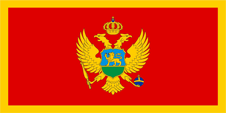
seit 2004,
National-, Staats und Handelsflagge,
Seitenverhältnis = 1:2,
Quelle, nach:
Wikipedia (EN)


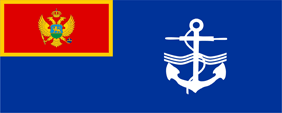
seit 2010,
Marineflagge,
Seitenverhältnis = 2:5,
Quelle, nach:
Wikipedia (EN)


1878–1880,
Handelsflagge,
Seitenverhältnis = 2:3,
Quelle, nach: Flags of the World
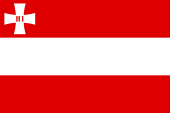
1880,
National- und Handelsflagge,
Seitenverhältnis = 2:3,
Quelle, nach: Flags of the World
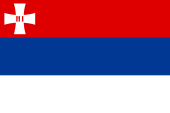
1880–1881,
National- und Handelsflagge,
Seitenverhältnis = 2:3,
Quelle, nach:
Flags of the World
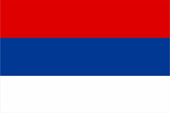
1881–1918,
National- und Handelsflagge,
Seitenverhältnis = 2:3,
Quelle, nach:
Flags of the World
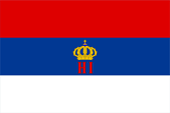
1881–1918,
Marine- und Kriegsflagge,
Seitenverhältnis = 2:3,
Quelle, nach:
Flags of the World
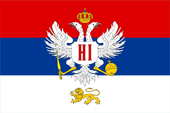
1910–1918,
Staatsflagge,
Seitenverhältnis = 2:3,
Quelle, nach:
World Statesmen
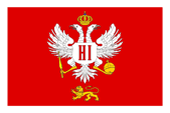
1910–1916,
Flagge des (letzten) Königs von Montenegro
Nikita (Nikolaus) I.,
Seitenverhältnis = 2:3,
Quelle, nach:
World Statesmen
1941–1944,
Nationalflagge,
Seitenverhältnis = 2:3,
Quelle, nach:
Wikipedia (EN)
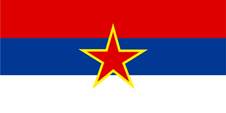
1947–1993,
Flagge Montenegros in der SFRJ,
Seitenverhältnis = 1:2,
Quelle, nach:
World Statesmen
1993–2004,
Landesflagge,
Seitenverhältnis = 1:3,
Quelle, nach:
Wikipedia (EN)
Die heutige Flagge Montenegros wurde am 12.07.2004 angenommen. Sie ist einfarbig rot mit einem goldenen Rand und zeigt in der Mitte einen goldenen Doppeladler. Im Brustschild des Adlers und unterhalb des Adlers ein goldener schreitender Löwe, ein altes montenegrinisches Nationalsymbol. Aus der Vergangenheit des Landes sind rote Flaggen bekannt, oft mit einem Kreuz oder mit einem Doppeladler. Alles heraldische Symbole, die auf das byzantinische Reich zurückreichen, denn Zeta, wie das Land früher hieß, war anfänglich ein byzantinisches Lehen. Die rote Flagge mit dem Doppeladler scheint sich als Flagge des Monarchen bis in die Neuzeit erhalten zu haben. Sie stand Modell für die heutige Flagge. Die Einführung einer Flagge als Nationalsymbol lies in Montenegro auf sich warten. Erst um 1878 sind weiße Flaggen mit einem roten Georgskreuz auf Handelsschiffen nachgewiesen. Nach dem Wiener Kongress im Jahre 1878 kam das Land unter österreichischen Schutz und die Handelsschiffe orientierten sich an den Farben Östereichs. Lediglich ein kleines Kreuz in der Oberecke markierte den Unterschied. Schon ein Jahr später wurde diese Flagge auf die Panslawischen Farben umgestellt, dem Modell Serbiens in rot-blau-weiß folgend. Viele slawische Völker schufen sich in der Zeit nach 1848 (dem Jahr der Revolutionen) – im Zusammenhang mit einem erstarkenden slawischen Nationalismus – eigene Flaggen. Dabei spielte der Panslawismus eine bedeutende Rolle, eine politische Bewegung des 18./19. Jahrhunderts, die alle Slawen in einer Nation einen wollte. Die meisten slawischen Völker lebten jedoch in dieser Zeit unter österreichischer, türkischer oder auch deutscher Herrschaft. Der Panslawismus sah in Russland ein Vorbild, denn die Russen waren, neben Serbien und Montenegro, die einzige freie slawische Nation. Und so wurden die Farben der russischen Flagge zum Idol der Panslawisten, und letztlich farbliches Vorbild bei der Gestaltung der Flaggen vieler slawischer Nationen. Diese Flaggen trugen und tragen bis auf wenige Ausnahmen die russischen Farben Weiß, Blau und Rot als gemeinsames Merkmal. Daher wird diese Farbkombination "Panslawische Farben" genannt. Die Monarchie wurde im Ersten Weltkrieg, an dem sich Montenegro auf der Seite der Entente beteiligte, im Jahre 1916 durch den Einmarsch von Truppen aus Österreich-Ungarn beendet und der König floh ins Ausland. Der König von Serbien einigte 1918 die südslawischen Völker unter seine Krone. Im Königreich der Serben, Kroaten und Slowenen (ab 1929 Jugoslawien genannt) gehörte Montenegro zur Banschaft (Provinz) Zeta. In der 1945 durch Tito proklamierten Föderativen Volksrepublik Jugoslawien konnten die südslawischen Nationen in ihren Republiken ihre Nationalfarben (meist Kombinationen der Panslawischen Farben) wieder auf eigenen Flaggen verwenden. Jedoch musste, wegen dem politischen System, ein roter Stern in der Mitte der Flagge verwendet werden. Mit dem Zusammenbruch des sozialistischen Systems verließen zwischen 1991 und 1992 Slowenien, Kroatien, Makedonien und Bosnien-Herzegowina den jugoslawischen Staat. Im April 1992 schlossen sich die beiden verbleibenden Staaten Serbien und Montenegro zur "Föderativen Republik Jugoslawien" zusammen, und am 27.04.1992 wurde der rote Stern ersatzlos von der Nationalflagge entfernt. Die beiden verbleibenden Mitgliedsstaaten verwendeten innerhalb des neuen Jugoslawiens gleiche Flaggen in rot-blau-weiß. Zur Unterscheidung wurde die Flagge Montenegros im Format 1:3 dargestellt. Im Jahre 2004 wurde dann die heutige Flagge Montenegros eingeführt, "Jugoslawien" hieß inzwischen "Bundesrepublik Serbien und Montenegro". Die Föderation wurde dann 2006 aufgelöst.
Quelle:
Die Welt der Flaggen,
Flaggen und Wappen der Welt,
Wikipedia (EN), Volker Preuß
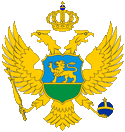
seit 2004,
Wappen von Montenegro,
Quelle: Wikipedia (EN)
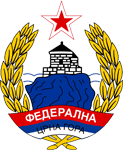
1945–1947,
Wappen von Montenegro,
Quelle, nach: User:Stefke, CC BY-SA 3.0, via Wikimedia Commons
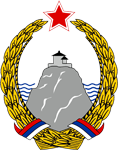
1947–1963,
Wappen von Montenegro,
Quelle, nach: w:en:User:Stefke, CC BY-SA 3.0, via Wikimedia Commons
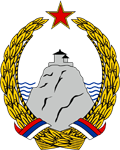
1963–1994,
Wappen von Montenegro,
Quelle, nach: User:Slashme, CC BY-SA 4.0, via Wikimedia Commons
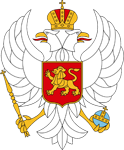
1994–2004,
Wappen von Montenegro,
Quelle: prof. Bogdan Kršić[3]([4] archived), Public domain, via Wikimedia Commons
Das Wappen Montenegros stammt in der oben gezeigten Form aus dem 19. Jahrhundert. Seine Wurzeln hat es jedoch im Mittelalter. Montenegro ist als serbisches Fürstentum aus den Trümmern des nach 1355 zerfallenen Großserbischen Reiches entstanden. An seiner Stelle befand sich zwischen dem 9. und dem Anfang des 12. Jahrhunderts das serbische Fürstentum Zeta, das ein Lehen des Byzantinischen Reiches war. So ist es kein Zufall, das die montenegrinische Heraldik mit dem silbernen Doppeladler an die Heraldik des Byzantinischen Reichs erinnert. Auch in der Religion setzte man das christlich-orthodoxe Erbe von Byzanz fort. Montenegros Doppeladler trägt und trug zeitweise ein Brustschild auf dem ein goldener, schreitender Löwe zu sehen ist. Zeitweise tauchte der Löwe auf Flaggen auf, außerhalb des Adlers, und dies vor allem dann, wenn im Brustschild die Initialen des Herrschers zu sehen waren. Über den Ursprung des Adlers ist nichts bekannt, möglicherweise ist er mit der Dynastie Njegoš in Verbindung zu bringen, die seit 1782 an der Macht war. Im sozialistischen Jugoslawien (1946–1992) wurde ein neues, mit kommunistischer Symbolik ausgestattetes Landeswappen angenommen. Es zeigte den Berg Lovcen im Süden Montenegros, auf den der Name des Staates zurückgeht.
Quelle:
Wikipedia (EN), Volker Preuß

2006–2018,
Flugzeugkokarde,
Quelle, nach: Wikipedia (EN)
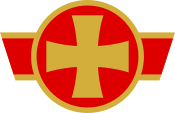
seit 2018,
Flugzeugkokarde,
Quelle, nach: Wikipedia (EN)
Lage:
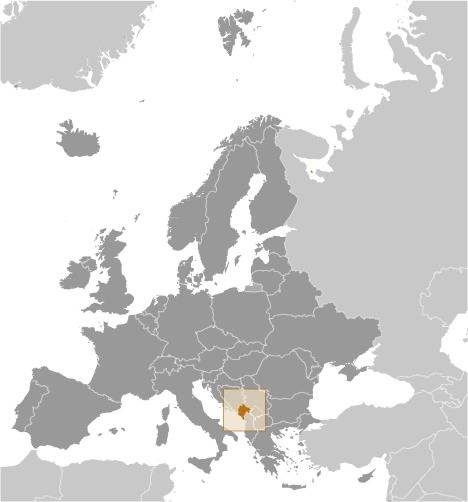
Quelle: CIA World Factbook
Landkarte des Landes:
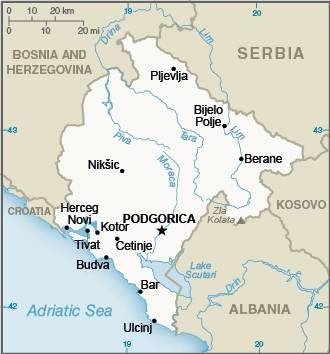
Quelle: CIA World Factbook
Die Staaten des früheren Jugoslawien:
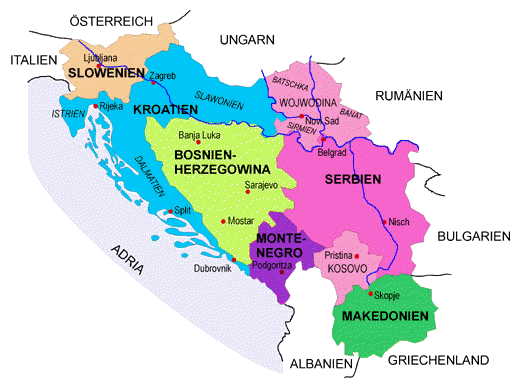
Landkarte/Map: Volker Preuß
Fläche: 13.812 km²
Einwohner: 621.000 (2020), davon 45% Montenegrinische Serben, 29% Serben, 9% Bosniaken, 5% Albaner
Religionen: 72% Serbisch-Orthodoxe Christen, 16% Moslems
Bevölkerungsdichte: 45 Ew./km²
Hauptstadt: Podgorica (Name 1946–1992: Titograd), 151.000 Ew. (2011)
Amtssprache: Montenegrinisch
sonstige Sprachen: Serbisch, Kroatisch, Bosnisch, Albanisch
Währung: 1 Euro (EUR, €) = 100 Cent
Zeitzone: MEZ
Quelle:
Wikipedia (D)
Antike · Besiedelung durch thrakische und illyrische Stämme
33–29 v.Chr. · römische Eroberung
395 · bei der Teilung des Römischen Reiches kommt das heutige Montenegro an das Oströmische Reich (Byzanz)
6./7. Jahrhundert · Einwanderung der Serben, Entstehung der serbischen Fürstentümer Zeta, Bosnien und Raschka (Raszien) als byzantinische Lehen
1040 · Zeta macht sich von Byzanz unabhängig
1077 · Zeta wird Königreich
1090 · Zeta vereinigt Bosnien und Raschka unter seiner Führung
1138 · Zeta verliert Bosnien und Raschka wieder
1168 · Raschka wird wieder byzantinisches Lehen
1180 · Raschka wird von Byzanz unabhängig
1183 · Raschka übernimmt die Macht in Zeta
1217 · Raschka wird zum Königreich Serbien erhoben
13./14. Jahrhundert · Serbien erobert Makedonien und Bosnien, Epirus, Thessalien und Albanien
1346 · Stephan Dusan wird zum "Kaiser der Serben und Griechen" gekrönt
1355 · Tod von Kaiser Stephan, das Großserbische Reich zerfällt in Einzelstaaten, in Zeta ergreift die Dynastie der Balschitschi die Macht
1371 · die Türken schlagen die Serben an der Maritza
1389 · die Türken schlagen die Serben auf dem Amselfeld, Serbien wird tributpflichtig, Zeta kann seine Unabhängigkeit bewahren
1421 · die Dynastie der Balschitschi endet
1427 · in Zeta ergreift die Dynastie der Tschernojevitschi die Macht
1499 · es gelingt den Türken die Ebenen von Zeta zu erobern, Zeta akzeptiert eine nominelle Osmanische Oberhoheit
ca.1500 · an der Küste eindringende Venezianer prägten für das Fürstentum Zeta den Begriff Montenegro ("Montagna negra" – ursprünglich gemeint war der wegen seines Basaltgesteins "Schwarzer Berg" genannte Berg Lovcen im Süden des Landes)
1516 · die Dynastie der Tschernojevitschi endet
1516–1697 · die Bischöfe von Tschetinje üben die Macht im Lande aus
1697 · der Metropolit Danilo Petrovic Njegoš (= Erzbischof Danilo, aus der Familie Petrovic, vom Stamme der Njegoš) ernennt sich zum Vladiken (geistlicher und weltlicher Herr Montenegros), und begründet somit die Monarchie neu
1685 · Montenegro wird faktisch vom Osmanischen Reich unabhängig
1798 · der türkische Sultan erkennt den Vladiken Peter II. Njegoš als Fürsten von Montenegro an
1852 · der Vladike Danilo Njegoš wandelt Montenegro in ein weltliches Fürstentum um und bindet sich politisch an Russland
1876 · Krieg Montenegros gegen das Osmanische Reich
1877–1878 · Montenegro beteiligt sich am russisch-türkischen Krieg, erhebliche Gebietsgewinne
1878 · Berliner Kongress, Montenegro bekommt weitere Gebiete zugesprochen, Annäherung an Österreich-Ungarn
1905 · Fürst Nikolaus erlässt eine Verfassung
1910 · Montenegro wird zum Königreich proklamiert
1912–1913 · Montenegro beteiligt sich an den Balkankriegen, erhebliche Gebietsgewinne
1914 · Montenegro beteiligt sich am Ersten Weltkrieg auf der Seite der Entente
1916 · österreichisch-ungarische Besetzung, der König flieht ins Ausland
1918 · die Monarchie wird abgeschafft, Montenegro wird Teil des "Königreichs der Serben, Kroaten und Slowenen", das 1929 in Jugoslawien umbenannt wurde, Montenegro wird Bestandteil der Banschaft (Provinz) Zeta
1941 · Jugoslawien wird im Verlauf des Zweiten Weltkriegs aufgelöst, Montenegro ist bis 1944 unabhängig
1941–1946 · Jugoslawien ist während des Zweiten Weltkriegs Schauplatz eines erbarmungslosen Partisanen- und Bürgerkriegs zwischen Kommunisten (unter J.P.Tito), Republikanern, Monarchisten und Nationalisten, die Kommunisten setzen sich durch
29.11.1945 · Ausrufung der "Föderativen Volksrepublik Jugoslawien" durch Tito
31.01.1946 · Ausrufung der Volksrepublik Montenegro (innerhalb des kommunistischen Jugoslawiens)
11.04.1963 · Ausrufung der Sozialistischen Republik Montenegro (innerhalb des kommunistischen Jugoslawiens)
03.08.1991 · Ausrufung der Republik Montenegro (innerhalb Jugoslawiens)
1991–1992 · Jugoslawien löst sich in seine Einzelstaaten auf
27.04.1992 · Serbien und Montenegro proklamieren die „Bundesrepublik Jugoslawien”
1991–1995 · Krieg zwischen Jugoslawien und Kroatien/Bosnien-Herzegowina
04.02.2003 · neue Verfassung, Jugoslawien wird durch die Bundesrepublik Serbien und Montenegro abgelöst
21.05.2006 · Volksabstimmung über eine Trennung von Serbien, 55,4% Zustimmung
13.07.2006 · Unabhängigkeitserklärung
Quelle:
Atlas zur Geschichte,
Wikipedia (D),
World Statesmen
An der Küste eindringende Venezianer prägten für das Fürstentum Zeta den Begriff Montenegro ("Montagna negra"). Das bezog sich ursprünglich auf den wegen seines Basaltgesteins "Schwarzer Berg" genannten Berges Lovcen im Süden des Landes.
Quelle:
Atlas der wahren Namen