mobile Ansicht, to the English Version tap the flag


- Föderation von Malaysia
- bundesstaatliche parlamentarische Wahlmonarchie
- Eigenbezeichnungen: Persekutan Tanah Malaysia
• Flaggen
• historische Flaggen
• Bedeutung/Ursprung der Flagge
• Wappen
• Bedeutung/Ursprung des Wappens
• Flugzeugkokarde
• Landkarte
• Bundesstaaten und Bundesterritorien
• Zahlen und Fakten
• Geschichte
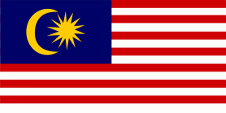
Nationalflagge und Gösch,
Seitenverhältnis = 1:2,
Quelle, nach: Flaggen und Wappen


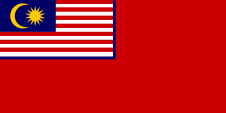
Handelsflagge,
Seitenverhältnis = 1:2,
Quelle, nach: Flaggen und Wappen

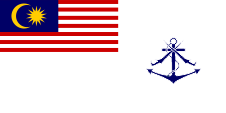
Marineflagge,
Seitenverhältnis = 1:2,
Quelle, nach: Flaggen und Wappen
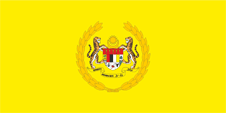
Flagge des Königs,
Seitenverhältnis = 1:2,
Quelle, nach: Flags of the World

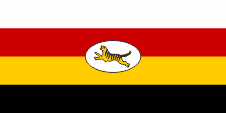
1895–1941,
Staatsflagge des Malaiischen Statenbundes,
Seitenverhältnis – ratio = 1:2,
Quelle, nach:
Flags of the World

1895–1941,
Gösch des Malaiischen Statenbundes,
Seitenverhältnis – ratio = 1:2,
Quelle, nach:
Flags of the World
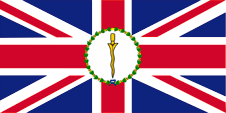
1911–1936,
Flagge des Chefsekretärs des Malaiischen Statenbundes,
Seitenverhältnis – ratio = 1:2,
Quelle, nach:
Flags of the World
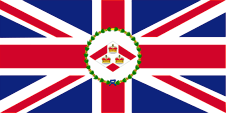
1936–1942,
Flagge des Oberkommissars des Malaiischen Statenbundes,
Seitenverhältnis = 1:2,
Quelle, nach:
Flags of the World
1946–1948,
Staatsflagge der Malaiischen Union,
Seitenverhältnis = 1:2,
Quelle, nach:
Flags of the World
1948–1950,
Staatsflagge der Malaiischen Föderation,
Seitenverhältnis = 1:2,
Quelle, nach:
Flags of the World
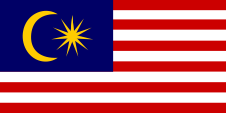
1950–1963,
Staatsflagge der Malaiischen Föderation,
Seitenverhältnis = 1:2,
Quelle, nach:
World Statesmen
Die heutige Flagge Malaysias ist nach dem Vorbild und Prinzip der USA-Flagge aufgebaut, und basiert auf der Flagge der Malaiischen Föderation. Sie besteht aus 14 waagerechten roten und weißen Streifen. Die blaue Oberecke zeigt einen gelben Halbmond und einen 14-strahligen gelben Stern. Die Zahl 14 steht für die Mitgliedsstaaten der Föderation. Die Flage wurde auch nach dem Ausscheiden Singapurs beibehalten. Die überzählige Sternen-Spitze bzw. Flaggen-Streifen steht nun für die Bundesterritorien. Diese Flagge wurde am 16.09.1963 eingeführt, als sich 11 malaiische Staaten mit Sabah, Sarawak und Singapur zum Staatenbund Malaysia zusammenschlossen. Die Farben der Flaggen werden auf zweierlei Art interpretiert:
• Rot und Weiß sind die malaiischen Nationalfarben, Gelb vertritt die Sultanate im Staatenbund, Blau erinnert an den langen britischen Einfluss. Stern und Halbmond sind islamische Symbole.
• Gelb steht für die einzelnen Sultanate und die Farben Blau, Weiß und Rot gehen auf die Farben Großbritanniens zurück. Stern und Halbmond sind islamische Symbole.
Die Flagge des Yang Di-Pertuan Agong (Staatsoberhaupt/Wahlkönig) ist gelb mit dem Wappen in einem Reisährenkranz in der Mitte. Malaysia orientiert sich am britischen Ensign-System. Das weißt auf die früheren kolonialen Bindungen zu Großbritannien hin. Großbritannien hatte in Jahr 1864 ein Flaggensystem eingeführt, in dem:
• Kriegsschiffe einen sogenannten "White Ensign" (Marineflagge), eine weiße Flagge oft mit durchgehendem roten Georgskreuz und mit dem Union Jack in der Oberecke,
• Handelsschiffe einen "Red Ensign" (auch "Civil Ensign" → Bürgerflagge genannt, die eigentl. Handelsflagge), eine rote Flagge mit dem Union Jack in der Oberecke, und
• Dienstschiffe einen "Blue Ensign" (Regierungsflagge → die eigentl. Staatsflagge), eine blaue Flagge mit dem Union Jack in der Oberecke führten.
Die malayischen Staaten, die teilweise bis heute existieren, hatten und haben und oft eine Vielzahl von eigenen Flaggen, z.B. eigene Nationalflaggen, Handelsflaggen oder auch Marine bzw. Kriegsflaggen. Deren Entstehungsgeschichte ist meist auf äußere Einflüsse zurückzuführen. Die Staaten Kelantan, Terengganu, Kedah und Perlis gehörten ursprünglich zu Siam (Thailand). Kedah und Perak gehörten im 17. Jahrhundert zeitweise zum Sultanat Aceh, und hatten dessen rote Flagge übernommen. Perlis hatte seine eigenen Farben und Kelantan und Terengganu hatten ab 1832, dem Jahr in dem sie sich teilweise von Siam lösten, einfarbige weiße Flaggen. Ein weiterer mächtiger Staat, der großen Einfluss in der Region hatte, war das Sultanat Lingga. Lingga hatte eine einfarbige schwarze Flagge, und bestand aus dem Archipel von Linga, heutigen Singapur und dem heutigen Johore. Der Staat Pahang war von Lingga abhängig, und führte dessen schwarze Flagge, jedoch ergänzt um einen weißen Streifen am Liek. Auch Terengganu ging dazu über seine weiße Flagge mit Schwarz zu ergänzen. Die Farben Rot, Schwarz, Weiß und Gelb waren also die bestimmenden Farben der malaiischen Flaggengeschichte, so dass es nicht verwunderlich ist, dass diese Farben in der Flagge der verschiedenen Malaiischen Staatenbünde verwendet wurden:
1895–1941 • Malaiischer Statenbund
1946–1948 • Malaiische Union
1948–1950 • Malaiische Föderation
Die Malaiische Union wurde 1948 reorganisiert und zur Malaiischen Föderation unter einem britischen Hochkommissar umgebaut, die 1957 als Königreich Malaiische Föderation die Unabhängigkeit von Großbritannien erreichte. 1963 erfolgte dass die Gründung des Königreiches Malaysia. Die ab 1948 gemeinsame Wirtschafts- und Verteidigungspolitik machte die Marine- und auch Handelsflaggen der Mitgliedsstaaten überflüssig. Ihre Nationalflaggen konnten sich dagegen bis heute halten. Die Farben präsentieren nicht nur die alten einfarbigen Flaggen der Malaiischen Staaten, sondern haben in Malaysia ihre ganz eigene Bedeutung: Rot steht oft für das Volk, und Weiß für den Herrscher. Die Monarchen der Malaienstaaten, die damals meist Rhadschas oder Maharadschas waren, verwendeten daher weiße Flaggen. Deren Statthalter oder Premierminister (Temenggong) zeigten gelbe Flaggen, und die Zweiten Minister (Bendahara) schwarze Flaggen. In einigen Fällen ist Gelb die Farbe des Herrschers, und Weiß die des Temenggong. Damit passte man sich der Tradition in dieser Region der Erde an, dass eigentlich die Farbe Gelb den König und die Königswürde repräsentiert. Die Kombination von Weiß und Rot gilt als die malaiischen Nationalfarben, jedoch sind sie im gesamten indonesisch-malaiisch-polynesischen Raum als Nationalfarben präsent.
Quelle:
Die Welt der Flaggen,
Flaggen Wappen Hymnen,
Flaggen-Atlas Erde,
Die Welt im bunten Flaggenbild,
Volker Preuß
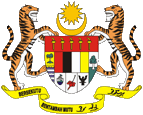
Wappen von Malaysia,
Quelle, nach:
Corel Draw 4
Das Staatswappen zeigt einen von zwei Tigern gehaltenen Wappenschild. Es basiert auf den Farben der alten föderierten Staaten, mit Feldern für Melakka und Pinang und einem Schildhaupt mit fünf Kris (Krummdolchen) für die historischen nichtföderierten Staaten. Unterhalb des Wappenschildes ein Spruchband mit dem Staatsmotto: "Bersekutu Bertambah Mutu" → "Einigkeit macht stark". 1963 wurden Felder für Singapur, Sabah und Sarawak hinzugefügt. Zwischen den Symbolen von Sabah und Sarawak befindet sich seit 1967 eine Hibiskusblüte. Sie ersetzt das Symbol von Singapur, das 1965 die Föderation verlassen hatte. Sobald sich das Wappen eines Teilstaates ändert, muss auch das entsprechende Feld auf dem Bundeswappen abgeändert werden. Das war bisher recht häufig der Fall.
Quelle:
Die Welt der Flaggen,
Flaggen Wappen Hymnen,
Flaggen-Atlas Erde,
Volker Preuß

seit 1982
Flugzeugkokarde,
Quelle, nach: Wikipedia (EN)
Lage:
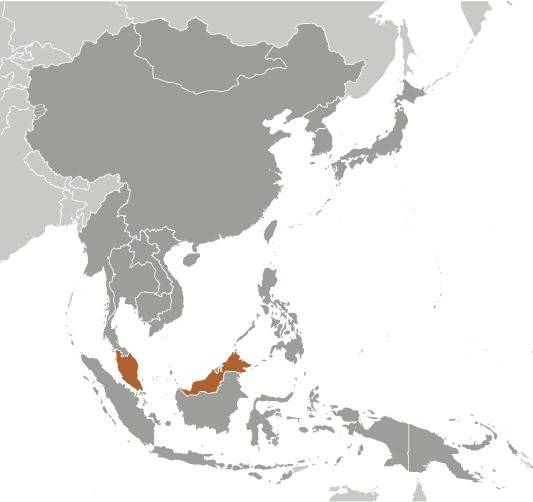
Quelle/Source: CIA World Factbook
Landkarte des Landes:
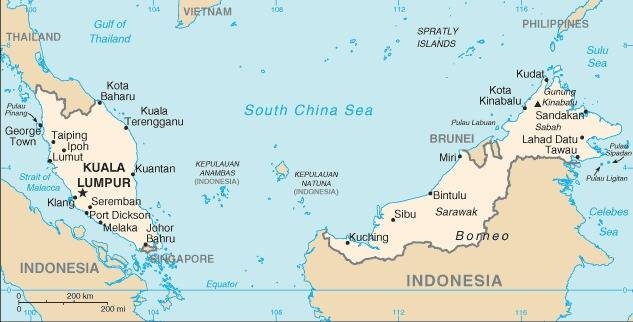
Quelle/Source: CIA World Factbook
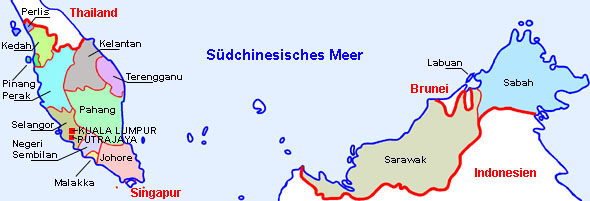
Landkarte/Map: Volker Preuß
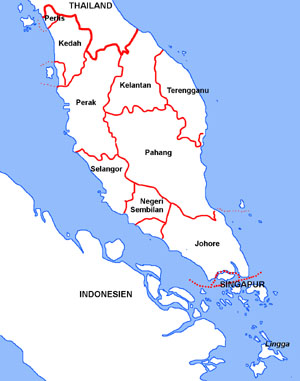
Bundesstaaten
"Föderierte Malayenstaaten":
• Perak
• Pahang
• Selangor
• Negeri Sembilan
"Nichtföderierte Malayenstaaten":
• Kedah
• Perlis
• Kelantan
• Terengganu
• Johore
ehemalige "Straits Settlements":
• Malakka
• Pinang
1963 angegliedert:
• Sabah
• Sarawak
Bundesterritorien
• Kuala Lumpur
• Putrajaya
• Labuan
Fläche: 330.290 km²
Einwohner: 32.400.000 (2020), davon 50% Malaien, 23% Chinesen, 11% Ureinwohner (Senoi, Semang ...), 7% Inder
Religionen: 61% Moslems, 20% Buddhisten, 9% Christen, 6% Hindus
Bevölkerungsdichte: 98 Ew./km²
Hauptstadt: Kuala Lumpur, 1.982.112 Ew. (2020)
Amtssprache: Malaysisch (Bahasa Malaysia)
sonstige Sprachen: Chinesisch, Tamil, Englisch
Währung: 1 Ringgit (MYR, R) = 100 Sen
Zeitzone: MEZ + 7 h
Quelle:
Wikipedia (D)
7.–12.Jhd. · Westmalaysia (Malaya) zum Reich Shrividjaja
14.–15.Jhd. · zum Reich Madjapahit
15.Jhd. · Entstehung der malaiischen Staaten in Malaya
16.Jhd. · portugiesische Kolonisierungsversuche in Malaya
17.Jhd. · örtliche niederländische Kolonisierung in Malaya
1786 · die Briten (Ostindienkompanie) setzen sich in Penang (Pinang) fest, 1800 folgen Wellesley, 1819 Singapur, 1824 Malakka, 1826 Pankor
1824 · die Niederländer verlassen Malaya
1826 · die britischen Besitzungen der Ostindienkompanie werden zu den "Straits Settlements" zusammengefasst
1873–1888 · Großbritannien errichtet sein Protektorat über vier Malaienstaaten (Perak, Pahang, Selangor, Negeri Sembilan)
1895 · Perak, Pahang, Selangor, Negeri Sembilan werden zu den "Föderierten Malaienstaaten" zusammengefasst (Malaiischer Bund, bis 1941)
1909 · Siam (Thailand) muss die Malaienstaaten Perlis, Kedah, Kelantan und Terengganu (bis dato nur lockere siamesische Oberhoheit) offiziell an Großbritannien abtreten → "Nichtföderierte Malaienstaaten"
1941 · japanische Eroberung
1945 · Abzug der Japaner
01.04.1946 · Bildung der Malaiischen Union durch Zusammenschluss der Malaiischen Sultanate (Britische Protektorate) und der Straits Settlements (Britische Kronkolonien), jedoch ohne Singapur. Die Straits Settlements werden teilweise als eigenständige Malaienstaaten zu britischen Protektoraten (Malakka, Pinang), teilweise werden sie dem Malaienstaat Perak angegliedert (Pankor, Dindings)
01.02.1948 · Reorganisation der Malaiischen Union, Bildung der Malaiischen Föderation unter einem britischen Hochkommissar
31.08.1957 · Unabhängigkeit und Proklamation des Königreiches Malaiische Föderation
16.09.1963 · Proklamation des Königreiches Malaysia durch Zusammenschluss der Malaiischen Föderation (Malaya) mit den ehemaligen britischen Kolonien Sarawak, Sabah (Nordborneo) und Singapur. Brunei lehnte den Beitritt ab und verblieb bei Großbritannien
09.08.1965 · Singapur verlässt die Föderation von Malaysia
1993 · Verfassungsreform, die Sultanate büßen teilweise ihre Unabhängigkeit ein
Quelle:
Atlas zur Geschichte,
Weltgeschichte,
Discovery '97,
Wikipedia (D)
Mit freundlicher Untersützung von: E. Hoheisel (D)