mobile Ansicht, to the English Version tap the flag

- Kärnten
- Bundesland der Republik Österreich
- ehemaliges österreichisches Kronland: Herzogtum Kärnten
• Flaggen
• historische Flagge
• Bedeutung/Ursprung der Flagge
• Wappen
• Bedeutung/Ursprung des Wappens
• Landkarte der Bundesländer Österreichs
• Landkarte der früheren Kronländer Österreich-Ungarns (bis 1918)
• Zahlen und Fakten
• Geschichte
• Ursprung des Landesnamens
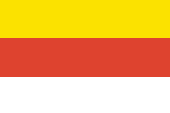
Landesflagge (Landesfarben),
Seitenverhältnis = 2:3,
Quelle, nach: Wikipedia (D),
Färbung, nach: Dr. Peter Diem www.peter-diem.at


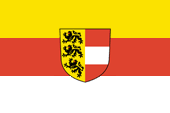
Dienstflagge,
Seitenverhältnis = 2:3,
Quelle, nach: Wikipedia (D),
Färbung, nach: Dr. Peter Diem www.peter-diem.at




bis 1918 (–1946?),
Landesflagge (Landesfarben),
Seitenverhältnis = 2:3,
Quelle, nach:
Österreichisch-Ungarische Wappenrolle
Die Flagge von Kärnten zeigt drei Streifen in Gold, Rot und Weiß und wurde
zuletzt am 18.06.1946 offiziell bestätigt. Die Farben der Flagge leiten sich aus
den Farben des Wappens ab.
In der Zeit der Monarchie hatte das Land, wie alle Kronländer der österreichischen Krone, seine eigenen, sogenannten Landesfarben, die unter anderem auf horizontal getreiften zwei- oder dreistreifigen Flaggen gezeigt wurden. Die Landesfarben waren sehr oft dem jeweiligen Wappen des Kronlandes entnommen oder wurden duch eine weitere, nicht im Wappen enthaltene Farbe ergänzt, oder sie gingen auf ältere Modelle des Landeswappens zurück (z.B. Krain). Offiziell waren die Landesfarben aber nie geregelt oder festgelegt worden, so dass deren Reihenfolge in der Praxis of variierte oder die Farben gar an sich abwichen. Der österreichische Heraldiker Hugo Gerard Ströhl (1851–1919) hat sich wohl als erster des Themas angenommen und wahrscheinlich um das Jahr 1890 herum die Landesfarben auf den Flaggen bei den jeweiligen Landesbehörden abgefragt und zusammengestellt. Für Kärnten wurden Rot und Weiß als Landesfarben für das Kronland ermittelt.
Österreich trat 1938 als ein Land dem Deutschen Reich bei. Die föderalen Strukturen spielten keine Rolle, sie wurden komplett durch die Gaue der NSDAP abgelöst, die Länder wurden abgeschafft. Ämter und Behörden hatten ab jetzt die Dienstflagge des Reiches zu verwenden. Die entsprechenden Landesfarben existierten möglicherweise weiter, auf jeden Fall aber nicht in Form von Flaggen. Sie wurden möglicherweise vereinzelt an Uniformen der SA oder bei bestimmten Dienstgraden der Hitlerjugend in der Brustschnur verwendet.
Die Flaggen der Österreichischen Bundesländer werden mit oder ohne Wappen gezeigt. Amtlich verwendet, tragen sie immer das Wappen, jedoch darf auch die Bevölkerung Flaggen mit Wappen verwenden.
Für die Farben der Flaggen der österreichischen Bundesländer scheint es keine gesetzlichen Regelungen zu geben, sie werden, da offenbar nicht definiert, in der Praxis in einem gewissen Standardbereich wiedergegeben. Der österreichische Publizist und Medienwissenschaftler Dr. Peter Diem gibt aber Empfehlungen für die Wiedergabe der Farben: Für Kärnten ein helles Rot, am ehesten Pantone 179 entsprechend, und Gelb als 100% Y.
Quelle: Dr. Peter Diem austria-forum.org,
Wikipedia (D),
Flaggen Enzyklopädie,
Volker Preuß,
Österreichisch-Ungarische Wappenrolle
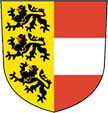
seit 1930,
Wappen von Kärnten,
Quelle, nach: Wikipedia (D)
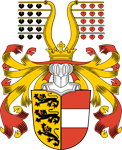
großes Wappen von Kärnten,
Quelle, nach: Unknown author / Public domain via Wikipedia (D)
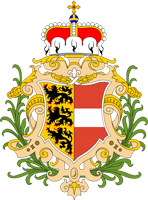
ca.1890–1918,
Wappen Herzogtum Kärnten,
Quelle, nach: Ströhl, Wappenrolle Österreich-Ungarns, 1890, via Wikipedia (D)
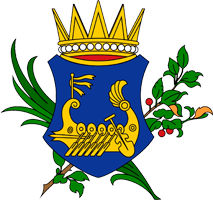
1814–1849,
Kärnten gehört zum Habsburgischen Königreich Illyrien,
Quelle, nach: Ströhl, Wappenrolle Österreich-Ungarns, 1890, via Wikipedia (D)
Das heutige Wappen Kärntens wurde im Jahre 1930 eingeführt. Das Wappen geht bis ins 13. Jahrhundert zurück. Es zeigt einen gespaltenen Schild: im linken Feld die eigentliche Heraldik von Kärnten, drei schwarze Löwen auf Gold, im rechten Feld den österreichischen Bindenschild der Babenberger. Die drei schwarzen Löwen auf Gold gehen auf die Staufischen Babenberger von Mödlingen zurück. Der Babenberger rot-weiß-rote Bindenschild wurde im Jahre 1246 eingefügt, da Herzog Ulrich III. Erbansprüche auf das Herzogtum Österreich geltend machte. Trotz erlöschen der Ansprüche im Jahre 1269 blieb das Wappen in dieser Form erhalten. Kärnten verwendet als einziges Bundesland Österreichs eine Wappenvariante als großes Wappen. Bis 1930 trug das Wappen eine Krone. Die Krone auf dem Wappen war zur Zeit der Monarchie ein üblicher Fürstenhut. Der österreichische Heraldiker Hugo Gerard Ströhl hat das Wappen um 1890, in seiner letzten bekannten Ausführung, mit landestypischer Flora umgeben. Für das Herzogtum Kärnten waren das stilisierte Schilfblätter, welche an die vielen Seen des Landes erinnern sollten.
Quelle: Wikipedia (D),
Flaggen Enzyklopädie,
Österreichisch-Ungarische Wappenrolle
Lesen Sie hier:
Hintergründe, Geschichte und Fakten zum Thema "Der Löwe in der Heraldik". Ausführungen, Varianten, Entwicklung, sowie Panther und Leoparden.

Die Bundesländer Österreichs:
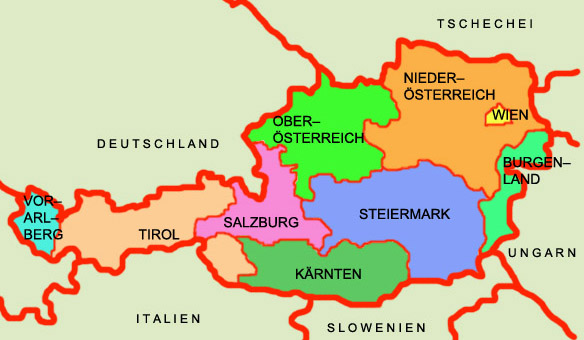
Quelle: Volker Preuß
• Burgenland
• Kärnten
• Niederösterreich
• Oberösterreich
• Salzburg
• Steiermark
• Tirol
• Vorarlberg
• Wien
Karte ca. 1910:
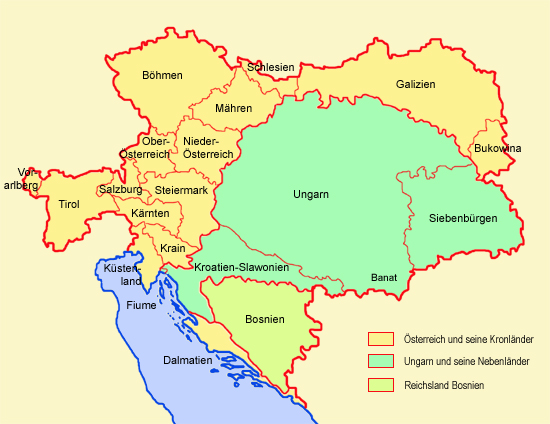
Quelle: Volker Preuß
Fläche: 9.538 km²
Einwohner: 561.000 (2019), davon 90% deutschsprachige Österreicher, 2% Slowenen
Bevölkerungsdichte: 59 Ew./km²
Hauptstadt: Klagenfurt, 100.800 Ew. (2019)
Amtssprache: Deutsch
sonstige Sprache: Slowenisch
Währung: 1 Euro = 100 Cent
Zeitzone: MEZ
Quelle: Wikipedia (D)
200 v.Chr. · Besiedlung durch Kelten
15 v.Chr.–46 n.Chr. · beginnende römische Eroberung, Errichtung der Provinz Noricum
4./5. Jhd. · Invasion der Goten
409–452 · Hunneneinfälle
6. Jhd. · Besiedlung durch Slawen, insbesondere durch den slawischen Stamm der Karantanen
ca. 750 · Herzog Tassilo III. von Bayern erobert das heutige Kärnten
788 · Bayern und Karantanien (erste Erwähnung dieses Namens) wird durch das Frankenreich der Karolinger unterworfen
803 · Einrichtung der "Karantanischen Mark"
976 · Bildung des Herzogtums Kärnten, dabei Angliederung der Marken Istrien und Krain
1047 · das Haus Welf (Schwäbische Welfen) erhält die Herzogswürde (bis 1055)
1077 · das Haus Eppenstein erhält die Herzogswürde
1122 · das Haus Sponheim erhält die Herzogswürde
1286 · das Haus Görz erhält die Herzogswürde
1335 · das Haus Habsburg erhält durch Erbschaft die Herzogswürde
1394 · Krain (einschl. Istrien) wird selbstständiges Habsburgisches Herzogtum
13./14. Jhd. · Besiedlung durch Deutsche
15. Jhd. · Türkeneinfälle
1797–1809 · Französische Revolutionskriege: ein Teil Österreichs (Steiermark) wird 1797 von den Franzosen besetzt
1809 · Friede von Wien, Österreich verliert Salzburg, das Innviertel, Westgalizien und Teile von Ostgalizien und tritt Istrien, Triest, Görz, Krain, Kärnten, Kroatien, und Dalmatien an Frankreich ab, die 1810 zu den französischen "Illyrischen Provinzen" zusammengefasst werden
1814 · Wiener Kongress, das Kaiserreich Österreich (Haus Habsburg) erhält die 1809 verlorenen Gebiete zurück, sie werden zum Habsburgischen Königreich Illyrien zusammengefasst, Kärnten wird Teil des Habsburgischen Königreichs Illyrien
1848/1849 · Revolution, neue Verfassung: die Titular-Erblande der Habsburger im Kaiserreich Österreich werden zu Kronländern mit eigenen Landtagen umgewandelt, Ende des Königreichs Illyrien, das Herzogtum Kärnten wird ein Kronland des Kaiserreichs Österreich
12.11.1918 · Proklamation von Deutsch-Österreich zur Republik Österreich, Kärnten wird österreichisches Bundesland
10.10.1920 · Volksabstimmung in Südkärnten für den Verbleib bei Österreich und gegen einen Anschluss an Jugoslawien
13.03.1938 · Anschluss ganz Österreichs an das Deutsche Reich, an die Stelle des Landes Kärnten tritt der "NS-Gau Kärnten"
27.04.1945 · Proklamation der Republik Österreich "Zweite Republik", Kärnten wird erneut österreichisches Bundesland, bleibt jedoch bis 1955 von britischen Truppen besetzt
1955 · Abzug der Besatzungstruppen
Quelle: Atlas zur Geschichte,
Wikipedia (D),
World Statesmen,
RetroBib Retrobibliothek,
Discovery '97,
Volker Preuß
Der Name "Kärnten" geht auf die Bezeichnung der Keltischen Bergbewohner, der "Karner" zurück. Dieser Name hat sich sogar auf die später eingewanderten Slawen übertragen, die sich "Karantanen" nannten. "Kärnten" ist also eine Kurzform von "Karantanien".
Quelle: Handbuch der geographischen Namen
weitere Seiten zu Österreich (historische Flaggen und Wappen):
• Reich der Österreichischen Habsburger (bis 1804)
• Kaiserreich Österreich (1804–1867)
• Österreich-Ungarn (1867–1918)
• Republik Österreich (seit 1918)